
How 3D Inspection Supports Metal Additive Manufacturing
Introduction
Metal additive manufacturing has evolved from a rapid prototyping technology into a reliable production method for high-performance industrial components. Industries such as aerospace, automotive, medical, defense, and energy increasingly rely on metal 3D printing to manufacture lightweight, complex, and customized parts.
While additive manufacturing offers exceptional design freedom, it also introduces unique quality challenges. Variations in thermal behavior, residual stress, distortion, and dimensional inconsistencies can affect the performance of finished components.
This is where 3D inspection services play a critical role. By capturing precise geometric data and comparing manufactured parts against CAD models, manufacturers can verify dimensional accuracy, detect defects early, and maintain consistent quality throughout production.
Why Quality Assurance Is Critical in Metal Additive Manufacturing
Unlike conventional machining, metal additive manufacturing builds components layer by layer. Every deposited layer influences the structural integrity of the final product.
Even small deviations can accumulate throughout the build process, leading to dimensional inaccuracies, warping, or surface imperfections.
Traditional inspection methods often struggle to evaluate complex geometries, internal channels, lattice structures, and freeform surfaces commonly found in additively manufactured components.
Advanced 3D inspection enables manufacturers to validate these intricate features without compromising measurement accuracy.
Understanding the Challenges of Metal Additive Manufacturing
Producing metal components through additive manufacturing involves several variables that influence final quality.
Common manufacturing challenges include:
-
Thermal distortion during printing
-
Residual stress accumulation
-
Surface roughness variations
-
Shrinkage after heat treatment
-
Build orientation effects
-
Support structure removal errors
-
Dimensional deviations
-
Complex internal geometries
Without accurate inspection, these issues may remain undetected until assembly or field operation.
How 3D Inspection Works
Modern 3D inspection combines high-accuracy laser scanners or structured light scanners with advanced inspection software.
The scanning system captures millions of measurement points across the component surface.
This data creates a detailed digital representation that can be directly compared with the original CAD model.
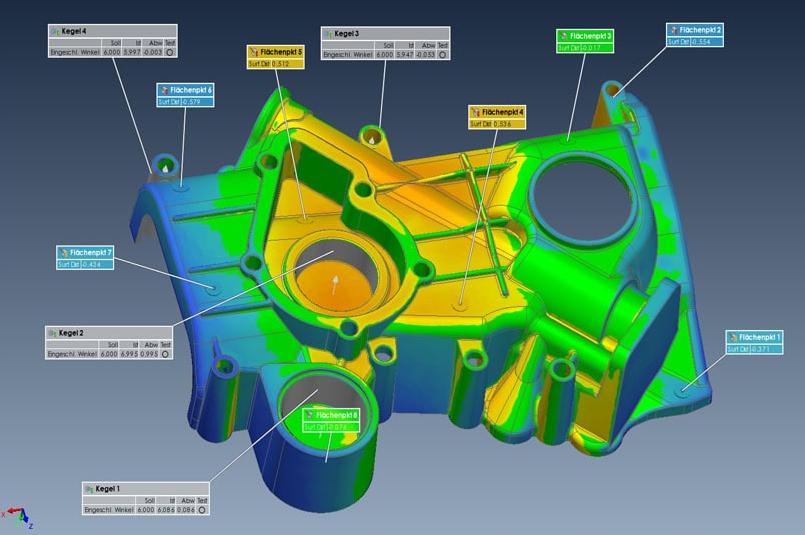
Engineers can quickly identify deviations through color deviation maps, dimensional reports, GD&T analysis, and feature-based measurements.
The result is objective, repeatable, and highly accurate quality verification.
Ensuring Dimensional Accuracy
Dimensional accuracy remains one of the primary quality requirements in additive manufacturing.
Complex metal parts often contain thin walls, intricate cooling channels, lattice structures, and curved surfaces that are difficult to measure using conventional tools.
3D inspection provides complete surface coverage instead of relying on limited measurement points.
This enables manufacturers to verify every critical feature while maintaining micron-level accuracy where required.
Detecting Distortion and Warpage
Thermal expansion and contraction during metal printing frequently lead to distortion.
Warped components may fail during assembly or reduce operational performance.
3D inspection compares scanned data against nominal CAD geometry to visualize even the smallest distortions.
Color deviation analysis allows engineers to quickly identify affected regions and determine whether corrective action is necessary.
Supporting Process Validation
Inspection data provides valuable insight beyond pass-or-fail decisions.
Manufacturers can analyze recurring dimensional variations across multiple production batches.
These insights help optimize:
-
Laser parameters
-
Build orientation
-
Powder distribution
-
Support placement
-
Cooling strategies
-
Heat treatment processes
Continuous process improvement becomes possible through measurable inspection data.
Improving First-Time Build Success
Failed metal builds are expensive.
Material costs, machine time, energy consumption, and post-processing all contribute to production expenses.
Comprehensive inspection helps manufacturers identify process deviations before they become recurring problems.
Improved process control increases first-pass yield while reducing costly rework and scrap.
Validating Complex Internal Features
Many metal additive manufacturing applications include internal cooling channels and lightweight lattice structures.
These features cannot always be verified using traditional inspection methods.
Advanced scanning technologies combined with digital inspection techniques allow manufacturers to validate accessible complex geometries more effectively.
Accurate verification ensures functional performance without compromising design intent.
Enhancing Reverse Engineering Workflows
Metal additive manufacturing frequently supports legacy component replacement where original CAD models no longer exist.
Reverse engineering creates accurate digital models from physical parts.
3D inspection complements this process by validating newly manufactured components against reconstructed CAD data.
The combination improves dimensional consistency throughout the product lifecycle.
Supporting Regulatory Compliance
Industries such as aerospace, healthcare, and defense require strict quality documentation.
Inspection reports generated from digital measurement systems provide traceable evidence of dimensional compliance.
Manufacturers can maintain detailed records for audits, customer approvals, and regulatory requirements.
This strengthens quality management systems while improving customer confidence.
Accelerating Product Development
Prototype evaluation is significantly faster when comprehensive inspection data is available.
Instead of manually measuring selected dimensions, engineers receive complete surface comparisons within hours.
This accelerates design iterations and shortens product development cycles.
Faster validation supports quicker innovation without sacrificing quality.
Reducing Manufacturing Costs
Inspection is often viewed as an additional production expense.
In reality, accurate inspection reduces costs by preventing expensive downstream failures.
Manufacturers benefit from:
-
Lower scrap rates
-
Reduced rework
-
Faster root-cause analysis
-
Improved process capability
-
Better production consistency
-
Shorter inspection cycles
These improvements directly influence operational efficiency and profitability.
Integrating Inspection into Digital Manufacturing
Modern manufacturing increasingly relies on digital workflows.
Inspection data integrates with CAD, CAM, PLM, MES, and digital twin platforms to create connected manufacturing environments.
This enables real-time monitoring, historical quality analysis, and continuous process optimization.
Inspection becomes an active contributor to data-driven manufacturing rather than a standalone quality checkpoint.
Industry Applications
Metal additive manufacturing supported by advanced inspection delivers value across numerous sectors.
Examples include:
-
Aerospace turbine components
-
Automotive lightweight structures
-
Medical implants
-
Industrial tooling
-
Energy equipment
-
Oil and gas components
-
Heavy engineering
-
Precision mechanical assemblies
Each application benefits from accurate dimensional verification before deployment.
The Growing Demand for Professional Inspection Services
As additive manufacturing becomes more widely adopted, quality expectations continue to rise.
Manufacturers increasingly require comprehensive digital inspection to validate complex components while reducing production risks.
Organizations seeking reliable 3d inspection services in Chennai are adopting advanced scanning technologies to support precision manufacturing, quality assurance, and regulatory compliance.
Similarly, companies across multiple industries recognize that professional 3d inspection services provide the accurate measurement data necessary for repeatable production, continuous improvement, and confident decision-making.
Future Outlook
The future of metal additive manufacturing will be driven by intelligent inspection technologies.
Artificial intelligence, automated defect recognition, digital twins, and real-time quality monitoring will further enhance manufacturing precision.
Inspection data will increasingly guide production decisions rather than simply verify completed parts.
Manufacturers that integrate advanced inspection into their additive workflows will be better positioned to achieve higher quality, lower waste, and faster product development.
Conclusion
Metal additive manufacturing has transformed the way complex industrial components are designed and produced. However, achieving consistent quality requires more than advanced printing equipment.
Accurate dimensional verification, defect detection, process validation, and digital quality analysis make 3D inspection an essential part of modern additive manufacturing. By providing comprehensive measurement data, manufacturers can improve production efficiency, reduce waste, strengthen compliance, and ensure every component meets demanding engineering specifications.
R M Engineering Technologies is a specialist provider of on-site, mobile laser scanning services. We deliver a fast and cost-effective solution for the collection of physical data of an object in any desired environment.

 Turkish