
Faisal Hills Location Guide GT Road, M-1, M-2 and CPEC Connectivity
Location is the one factor that outlasts every other variable in property investment. Developers can upgrade amenities. Market cycles rise and fall. But where a society sits on the road map, and how that position links to the infrastructure around it, is permanent.
Faisal Hills sits at the meeting point of several road corridors that are already valuable or about to become far more so. This guide breaks down each one.
Where Faisal Hills Is Located
Faisal Hills is located on the N-5 Grand Trunk Road near Taxila, in Rawalpindi District. It falls within Zone 2 of Islamabad's planning area while sitting administratively inside District Rawalpindi.
The society lies at the western foothills of the Margalla Hills, between two major centers: Islamabad to the east and Taxila to the west. It avoids the traffic of both.
This boundary position is deliberate. Residents get the commuting advantage of Islamabad without the city's pricing premium or congestion.
GT Road (N-5): The Core Infrastructure Asset
Why GT Road Frontage Drives Long-Term Value
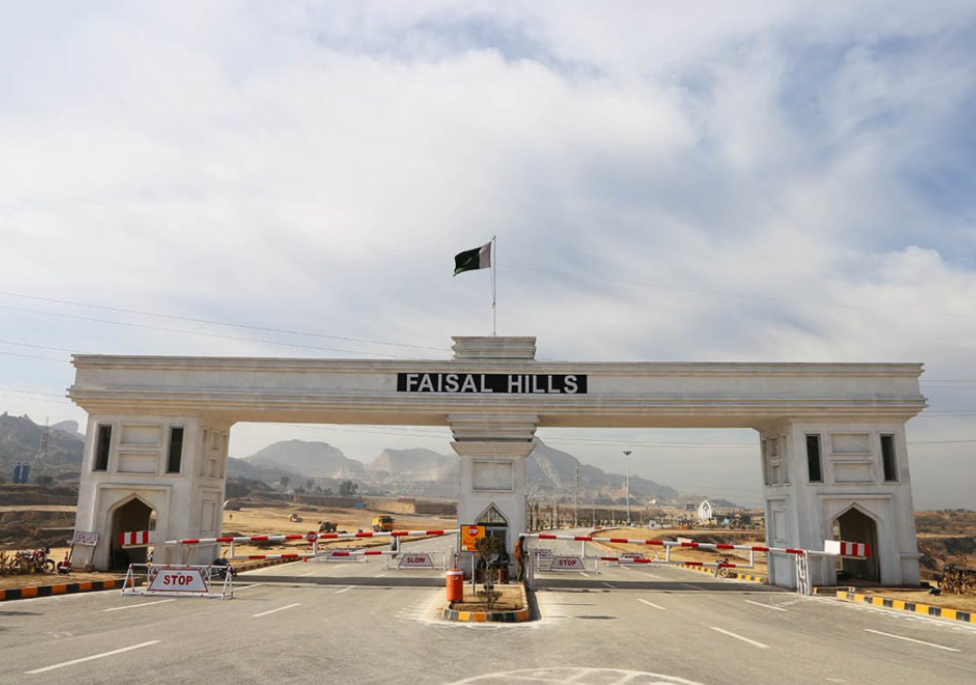
The N-5 Grand Trunk Road is one of Pakistan's oldest and most strategic national highways, maintained by the National Highway Authority. It runs from Peshawar through Rawalpindi, past Taxila, and on toward Lahore. Faisal Hills has direct frontage on this road, with two main entrances opening onto the N-5.
GT Road frontage cannot be added later. A society either has it or it does not. Faisal Hills has it, and that benefits every block regardless of development stage.
The Executive Block sits directly beside the GT Road. Faisal Jewel, Hill Walk Downtown, and other commercial developments are placed here because GT Road visibility means thousands of vehicles views every day, the foundation of strong commercial real estate.
Who Benefits Most from GT Road Access
• Residents: Taxila, Wah Cantt, Rawalpindi, and Islamabad are all reachable without entering city-center traffic.
• Commercial investors: Any business near the GT Road entrance gets built-in daily traffic. Brand visibility for Hill Walk Downtown and Executive Block units depends directly on this road.
• Commuters: Buses and wagons run between Rawalpindi Saddar and Taxila along the GT Road every day, so Faisal Hills is reachable without a personal car.
M-1 Motorway: Islamabad Access Without City Traffic
Current M-1 Connectivity
The Peshawar-Islamabad M-1 Motorway is about 22 minutes from Faisal Hills. The M-1 is a signal-free, dual-carriageway highway that cuts long-distance travel times sharply.
For air travel, the M-1 is the most practical route. Faisal Hills to Islamabad International Airport is about 25 km, or 20 to 25 minutes in normal traffic.
Block C and Its M-1 Advantage
Block C sits closest to the M-1 within the master plan. A planned interchange will connect Block C directly to the M-1 and cut its travel time to the motorway network.
Once that interchange opens, Block C's connectivity to Islamabad will improve sharply. This is a clear infrastructure-driven price catalyst, and a main reason Block C suits medium-term investors who enter ahead of the milestone.
M-2 Motorway: Block D's Key Differentiator
Current M-2 Proximity
The M-2 Motorway (Islamabad-Lahore) is about 25 minutes from Faisal Hills. Block D sits closest to it.
The Planned M-2 Interchange
A dedicated interchange connecting Block D directly to the M-2 is in the planning stage. Once built, it will give Block D near-direct access to Lahore, a route that now passes through Rawalpindi city traffic.
For Block D buyers, this interchange is the long-term catalyst to track. Property values near new motorway interchanges tend to rise in the years around the announcement and construction.
Block D received full possession in February 2025. It is one of the few blocks where investors can buy, build, and earn rental income today while the M-2 interchange develops.
CPEC Route: The Strategic Long-Term Play
What CPEC Means for GT Road Properties
The China-Pakistan Economic Corridor (CPEC) runs through the N-5 GT Road corridor, the same road Faisal Hills sits on. CPEC has already brought industry, infrastructure, and economic activity to the stretch through Taxila and Wah toward Islamabad. Project details are published on the CPEC Secretariat's official portal.
Properties on confirmed CPEC routes have a record of price appreciation in Pakistan. Faisal Hills is not near the CPEC route; it is on it. That is a structural advantage that does not depend on any single project.
Block C and the Future CPEC Connection
Block C has a planned link that will connect it more directly to the CPEC route via the M-1. Once complete, it will give Block C better access to the traffic and commerce along that corridor.
This is a three- to five-year play, not a 12-month one. For patient investors, today's entry price in Block C reflects an early position on a route that keeps gaining economic weight.
Margalla Avenue: The Route That Changed the Commute
Before Margalla Avenue, the commute from Faisal Hills to central Islamabad was long enough to put off most families. The Margalla Avenue extension changed that.
Today, via Margalla Avenue, Faisal Hills is about 23 to 37 minutes from central Islamabad, depending on traffic and starting point. That is competitive with societies that sit closer to the capital.
The result is stronger demand from families who want to live in Faisal Hills, not only trade files. That shift in buyer profile is a main driver of the steady price growth in Block A, Block B, and the Executive Block over the past two to three years.
Faisal Hills Distance Chart: Travel Times to Key Destinations
These are the key travel times buyers use to judge commute practicality.
|
Destination |
Travel Time From Faisal Hills |
|
Taxila City |
5 to 10 minutes |
|
B-17 MPCHS |
5 minutes |
|
Wah Cantt |
10 to 15 minutes |
|
M-1 Motorway |
22 minutes |
|
Islamabad International Airport |
20 to 25 minutes |
|
HITEC University Taxila |
10 to 12 minutes |
|
M-2 Motorway |
25 minutes |
|
Islamabad Blue Area |
30 to 45 minutes |
|
Rawalpindi Saddar |
35 to 40 minutes |
Why Location Drives Block Prices
Location explains why blocks are priced differently.
• Executive Block: the most expensive, thanks to GT Road frontage and direct main-entrance access. Maximum visibility, connectivity, and commercial value.
• Block A: mature infrastructure plus walking-distance access to the upcoming Arc Monument and Hill Walk Downtown.
• Block B: residential quality and Margalla Hills views, a lifestyle premium without the commercial noise of the entrance zone.
• Block C and Block D: priced lower today because their M-1 and M-2 connections are future, not current. Early buyers capture pre-catalyst pricing.
• Prime Block: main-entrance position near Taxila Chowk, a premium address with new underground infrastructure, still priced below comparable societies.
Frequently Asked Questions
Q1. How far is Faisal Hills from Islamabad International Airport?
About 25 km via the M-1 Motorway and GT Road. Travel time is 20 to 25 minutes in normal traffic, mostly signal-free.
Q2. Is Faisal Hills on the CPEC route?
Yes. The N-5 GT Road, where Faisal Hills has direct frontage, is part of CPEC infrastructure. Block C has a planned extra link to the CPEC route via the M-1.
Q3. Which block has the best motorway access?
Block D sits closest to the M-2 and a planned interchange, while Block C is nearest to the M-1 connection; both benefit from strong long-term growth catalysts and broader infrastructure improvements being delivered under the Rawalpindi Development Authority (RDA) development framework.
Q4. Is Faisal Hills in Islamabad or Rawalpindi?
Administratively, it is in Rawalpindi District near Taxila. It also falls within Zone 2 of Islamabad's planning area and is commonly called a society near Islamabad. Both cities are reachable in 30 to 40 minutes.
Q5. What is the best route from Islamabad to Faisal Hills?
Margalla Avenue is best for commuters from the F and E sectors (about 30 km, 23 to 37 minutes). GT Road from Rawalpindi suits residents of Saddar and nearby areas (35 to 40 minutes). The M-1 from the airport is the smoothest airport-to-home route (20 to 25 minutes).
Conclusion
Faisal Hills sits on one of the most infrastructure-rich road corridors in the Twin Cities region. GT Road frontage is immediate and permanent. M-1 and M-2 access is already practical. CPEC proximity is structural. Margalla Avenue has already reshaped the commute. The planned Block C and Block D interchanges are the next wave of location-driven price catalysts.
For buyers who know that location value compounds over time, Faisal Hills makes a case far stronger than its current pricing suggests.

 Turkish