
What is a Certificate of Incorporation? Meaning, Importance and Process
Introduction
Starting a business involves several legal and administrative steps. One of the most important milestones in the company registration process is obtaining a Certificate of Incorporation. This document serves as official proof that a company has been legally formed and recognized under the applicable laws.
Whether you are establishing a startup, a private limited company, a public limited company, or a one-person company, the Certificate of Incorporation is a fundamental legal document that confirms the existence of the business entity. Without it, a company cannot legally operate as a registered corporate entity.
In India, the Certificate of Incorporation is issued by the Registrar of Companies (ROC) under the Ministry of Corporate Affairs (MCA) after successful completion of the incorporation process. It contains essential details about the company and signifies that the company has been formed in accordance with the Companies Act, 2013.
This article explains the meaning, importance, and process of obtaining a Certificate of Incorporation and why it plays a crucial role in the life cycle of every company.
What is a Certificate of Incorporation?
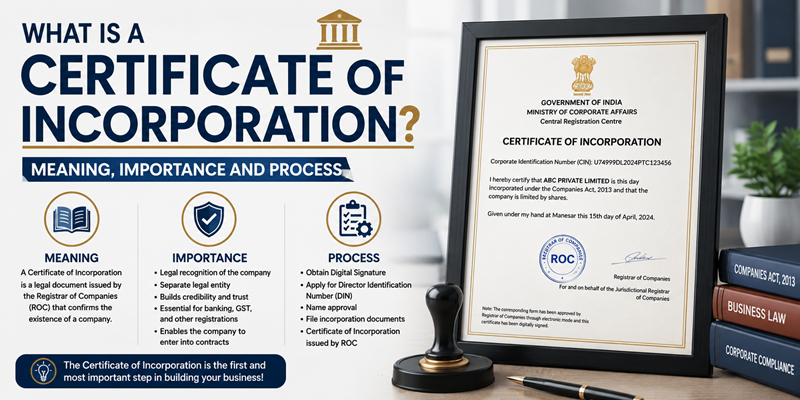
A Certificate of Incorporation is an official document issued by the Registrar of Companies confirming that a company has been legally registered under the Companies Act.
The certificate serves as evidence that all legal requirements relating to the incorporation of the company have been fulfilled and that the company now exists as a separate legal entity.
Once the Certificate of Incorporation is issued, the company acquires its own legal identity, distinct from its directors, shareholders, or promoters.
The document generally contains:
- Company Name
- Corporate Identification Number (CIN)
- Date of Incorporation
- Type of Company
- PAN and TAN details (where applicable)
- Registered Office State
- Signature and seal of the Registrar of Companies
The certificate is generated electronically and can be downloaded from the MCA portal.
Legal Significance of a Certificate of Incorporation
A Certificate of Incorporation is more than just a registration document. It provides legal recognition to a business and establishes its corporate identity.
Once incorporated, the company can:
- Enter into contracts in its own name
- Open bank accounts
- Own property and assets
- Borrow funds
- Initiate legal proceedings
- Be sued independently
- Conduct business operations legally
The certificate acts as conclusive proof that the company has been incorporated according to the law.
Why is a Certificate of Incorporation Important?
1. Establishes Legal Existence
The primary purpose of the Certificate of Incorporation is to confirm the legal existence of a company.
Before incorporation, a business may operate as a sole proprietorship or partnership. After incorporation, the company becomes a separate legal entity recognized by law.
This legal identity continues irrespective of changes in ownership or management.
2. Creates a Separate Legal Entity
One of the most significant benefits of incorporation is the creation of a separate legal personality.
This means that:
- The company owns its assets.
- The company incurs its liabilities.
- The company enters into contracts independently.
The personal assets of shareholders are generally protected from the company's liabilities, subject to applicable laws.
3. Enhances Business Credibility
A registered company often enjoys greater credibility among:
- Customers
- Investors
- Vendors
- Financial institutions
- Government authorities
The Certificate of Incorporation demonstrates that the business operates within a recognized legal framework and complies with regulatory requirements.
4. Required for Opening a Bank Account
Most banks require the Certificate of Incorporation as part of the documentation needed to open a current account in the company's name.
Without this document, many financial transactions may not be possible.
5. Essential for Regulatory Registrations
Businesses often require additional registrations such as:
- GST Registration
- Import Export Code (IEC)
- MSME Registration
- Professional Tax Registration
- Trade Licenses
The Certificate of Incorporation is frequently required during these registration processes.
6. Helps in Raising Funds
Investors and financial institutions generally seek proof of incorporation before investing in or lending to a company.
The certificate confirms that the company legally exists and is authorized to conduct business.
Information Included in the Certificate of Incorporation
The Certificate of Incorporation issued by the Registrar of Companies typically contains:
1. Company Name
The approved legal name under which the company is incorporated.
2. Corporate Identification Number (CIN)
A unique identification number assigned to every company registered in India.
3. Date of Incorporation
The official date on which the company came into legal existence.
4. Company Category
Details indicating whether the entity is a Private Limited Company, Public Limited Company, One Person Company, or another category.
5. Registered Office State
The state in which the registered office of the company is located.
These details collectively establish the legal identity of the organization.
Process of Obtaining a Certificate of Incorporation
Step 1: Obtain Digital Signature Certificate (DSC)
The incorporation process begins with obtaining Digital Signature Certificates for the proposed directors.
The DSC is used for electronic filing of incorporation documents.
Step 2: Apply for Director Identification Number (DIN)
Individuals intending to become directors must obtain a Director Identification Number.
The DIN serves as a unique identification number for directors.
Step 3: Company Name Approval
The proposed company name must be submitted for approval through the Ministry of Corporate Affairs.
The name should be unique and comply with applicable naming guidelines.
Step 4: Preparation of Incorporation Documents
The promoters must prepare and submit various incorporation documents, including:
- Memorandum of Association (MOA)
- Articles of Association (AOA)
- Identity Proof
- Address Proof
- Registered Office Details
- Declaration Forms
Proper documentation helps avoid delays in the approval process.
Step 5: Filing of Incorporation Application
The incorporation application is submitted electronically through the MCA portal using the prescribed forms.
The application contains all necessary information regarding the company and its directors.
Step 6: Verification by Registrar of Companies
The Registrar examines the application and supporting documents to ensure compliance with legal requirements.
If any discrepancies are found, additional clarification or corrections may be requested.
Step 7: Issuance of Certificate of Incorporation
Upon successful verification and approval, the Registrar issues the Certificate of Incorporation.
The company is officially incorporated from the date mentioned on the certificate.
Common Mistakes to Avoid During Incorporation
Businesses often encounter delays due to avoidable errors such as:
- Incorrect documentation
- Name conflicts
- Incomplete application forms
- Incorrect director information
- Address verification issues
- Non-compliance with MCA requirements
Careful planning and professional assistance can help ensure a smoother incorporation process.
Conclusion
The Certificate of Incorporation is one of the most important legal documents for any company. It serves as official proof that a company has been registered and recognized under the Companies Act.
Beyond legal recognition, the certificate enables businesses to open bank accounts, obtain registrations, enter contracts, raise funds, and establish credibility in the marketplace. For entrepreneurs and business owners, obtaining a Certificate of Incorporation is the first step toward building a legally compliant and professionally structured organization.
Understanding its significance and the process involved can help businesses navigate incorporation more effectively and lay a strong foundation for future growth.
Frequently Asked Questions (FAQs)
1. What is the purpose of a Certificate of Incorporation?
The Certificate of Incorporation confirms that a company has been legally registered and recognized under the Companies Act.
2. Who issues the Certificate of Incorporation in India?
The Certificate of Incorporation is issued by the Registrar of Companies (ROC) under the Ministry of Corporate Affairs (MCA).
3. Is a Certificate of Incorporation mandatory for company registration?
Yes. It is the official document that establishes the legal existence of a company after registration.
4. What information is included in a Certificate of Incorporation?
It generally includes the company name, CIN, date of incorporation, company type, and registered office state.
5. Can a company operate without a Certificate of Incorporation?
No. A company can legally operate as a registered corporate entity only after the Certificate of Incorporation has been issued by the Registrar of Companies.

 Turkish