
VPN Firewall Guide 2026: Security, Protection and Benefits
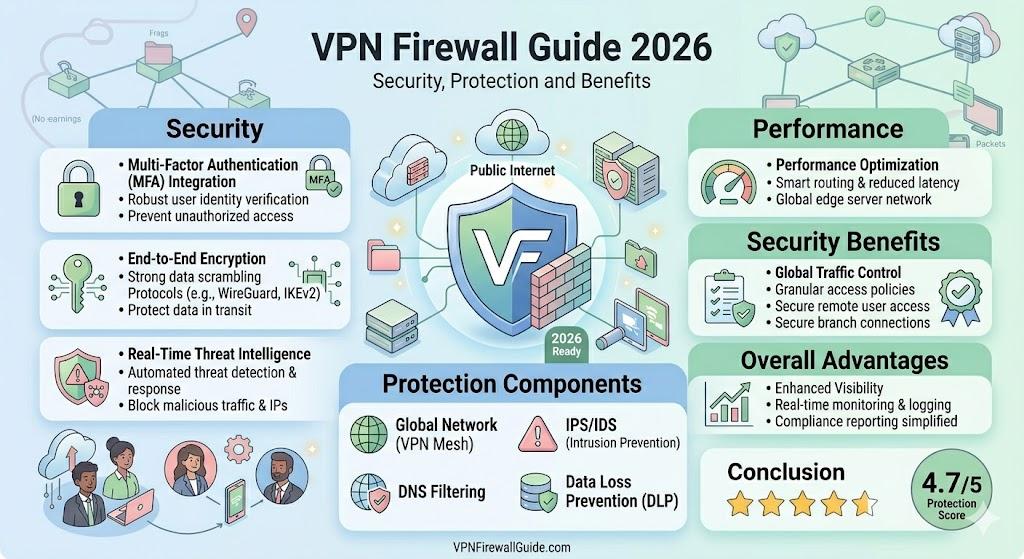
Cybersecurity threats continue to evolve as businesses and individuals increasingly rely on internet-connected devices. Protecting sensitive data, securing network traffic, and preventing unauthorized access have become top priorities in today's digital environment. Two technologies that play a major role in cybersecurity are Virtual Private Networks (VPNs) and firewalls. When combined, they create a powerful security solution often referred to as a VPN firewall.
A VPN firewall helps organizations and individuals strengthen network protection by combining encrypted communications with traffic monitoring and access control. This layered approach reduces security risks while improving privacy and network visibility.
In this comprehensive guide, we will explore what a VPN firewall is, how it works, its benefits, key features, use cases, and best practices for implementation.
What Is a VPN Firewall?
A VPN firewall is a security solution that combines VPN technology with firewall protection to secure internet communications and regulate network traffic.
A VPN encrypts data traveling between a device and a remote server, while a firewall monitors and filters network traffic based on predefined security rules.
Together, these technologies help:
- Protect sensitive information
- Prevent unauthorized access
- Secure remote connections
- Monitor network traffic
- Block malicious activity
This layered security model improves overall protection against cyber threats.
Understanding VPN Technology
A VPN creates an encrypted tunnel between a device and the internet.
When connected to a VPN:
- Data is encrypted.
- Internet traffic passes through a secure server.
- The user's IP address is masked.
- Online activity becomes more private.
VPNs are commonly used for:
- Remote work
- Secure browsing
- Public Wi-Fi protection
- Business connectivity
- Data privacy
However, while VPNs encrypt traffic, they do not inherently control what traffic enters or leaves a network. This is where firewalls become essential.
Understanding Firewall Technology
A firewall acts as a security barrier between trusted and untrusted networks.
Its primary purpose is to inspect and control traffic based on security policies.
Firewalls can:
- Allow approved traffic
- Block suspicious connections
- Monitor network activity
- Prevent unauthorized access
- Detect malicious behavior
Firewalls serve as the first line of defense against many cyber threats.
How a VPN Firewall Works
A VPN firewall combines encryption and traffic filtering into a unified security strategy.
The process typically works as follows:
- A user initiates a VPN connection.
- Data becomes encrypted.
- Traffic passes through the firewall.
- The firewall evaluates traffic against security policies.
- Approved traffic proceeds to its destination.
- Suspicious or unauthorized traffic is blocked.
This dual-layer approach helps protect both the data itself and the network through which it travels.
🛡️ Claim Your VPN Protection
Benefits of a VPN Firewall
Enhanced Security
One of the most important advantages is stronger overall protection.
The combination of encryption and traffic inspection helps defend against:
- Cyberattacks
- Malware
- Data interception
- Unauthorized access
Secure Remote Access
Organizations with remote employees benefit significantly from VPN firewall protection.
Remote workers can securely access:
- Company networks
- Internal applications
- Shared resources
- Cloud services
while maintaining strong security controls.
Improved Privacy
VPN encryption helps reduce exposure to:
- Network monitoring
- Data collection
- Tracking technologies
This improves privacy for both businesses and individuals.
Reduced Attack Surface
Firewalls help limit unnecessary network exposure by blocking unwanted traffic and restricting access to critical systems.
Types of VPN Firewalls
Hardware VPN Firewalls
These are dedicated security appliances deployed within network environments.
Benefits include:
- High performance
- Enterprise-grade security
- Centralized management
They are commonly used in large organizations.
Software VPN Firewalls
Software-based solutions run directly on devices or servers.
Advantages include:
- Easier deployment
- Lower initial costs
- Flexible configuration
These are popular among small businesses and individual users.
Cloud-Based VPN Firewalls
Modern organizations increasingly use cloud-delivered security services.
Benefits include:
- Scalability
- Simplified management
- Global accessibility
- Reduced infrastructure requirements
Cloud-based solutions are becoming increasingly common in hybrid work environments.
Key Features of a VPN Firewall
A quality VPN firewall should include several important capabilities.
Strong Encryption
Encryption protects data while in transit.
Common standards include:
- AES-256 encryption
- Secure key exchange
- Modern VPN protocols
Access Control
Administrators can define who can access network resources.
Access controls may be based on:
- User identity
- Device type
- Location
- Security posture
Traffic Monitoring
Monitoring capabilities help identify unusual network behavior.
Benefits include:
- Threat detection
- Usage visibility
- Faster troubleshooting
Intrusion Prevention
Many modern firewalls include intrusion prevention systems (IPS).
These systems help detect and block malicious activity before damage occurs.
Logging and Reporting
Detailed logs provide valuable information regarding:
- Security events
- Connection attempts
- User activity
- Policy violations
These insights support compliance and security investigations.
⬇️ Download a Trusted VPN
VPN Firewall for Businesses
Organizations face increasing cybersecurity challenges.
Common risks include:
- Ransomware
- Data breaches
- Insider threats
- Phishing attacks
VPN firewalls help businesses address these threats through centralized security management.
Supporting Remote Work
Hybrid work models require secure access from various locations.
VPN firewall solutions enable:
- Secure employee access
- Consistent policy enforcement
- Centralized visibility
Protecting Sensitive Data
Industries handling confidential information often rely on VPN firewall technology.
Examples include:
- Healthcare
- Finance
- Legal services
- Government agencies
Strong security controls help safeguard sensitive information.
VPN Firewall for Home Users
VPN firewall protection is not limited to businesses.
Home users can benefit from:
- Safer browsing
- Secure online banking
- Protected public Wi-Fi usage
- Enhanced privacy
Many consumer VPN providers include basic firewall-like features such as kill switches and network protection tools.
Common VPN Firewall Use Cases
Secure Branch Connectivity
Organizations often connect multiple offices through encrypted VPN tunnels protected by firewall policies.
Remote Employee Access
Employees can securely connect to internal resources while maintaining compliance with security standards.
Cloud Resource Protection
Businesses using cloud services can implement VPN firewalls to secure access to cloud environments.
Public Wi-Fi Security
Travelers and remote workers can reduce security risks when using public networks.
Best Practices for VPN Firewall Deployment
Use Strong Authentication
Implement:
- Multi-factor authentication
- Strong passwords
- Identity verification
Keep Software Updated
Regular updates address:
- Security vulnerabilities
- Performance issues
- Emerging threats
Monitor Activity
Continuous monitoring helps identify suspicious behavior before it becomes a serious issue.
Apply Least-Privilege Access
Users should receive only the permissions necessary for their responsibilities.
Conduct Regular Audits
Periodic reviews help ensure security policies remain effective.
VPN Firewall vs Traditional Firewall
| Feature | VPN Firewall | Traditional Firewall |
|---|---|---|
| Encryption | Yes | No |
| Traffic Filtering | Yes | Yes |
| Remote Access Security | Yes | Limited |
| Privacy Protection | Yes | No |
| IP Address Protection | Yes | No |
| Secure Public Wi-Fi Use | Yes | Limited |
The combination of VPN and firewall capabilities provides broader protection than a traditional firewall alone.
Future Trends in VPN Firewall Technology
Several developments are shaping the future of network security.
Zero Trust Security
Organizations increasingly adopt Zero Trust frameworks that verify every connection before granting access.
Cloud-Native Security
Cloud-based VPN firewall platforms continue gaining popularity.
AI-Powered Threat Detection
Artificial intelligence is improving the ability to detect suspicious behavior and emerging threats.
SASE Integration
Secure Access Service Edge (SASE) combines networking and security functions into unified cloud-delivered services.
These advancements are helping organizations simplify security while improving protection.
⭐ Find the Best VPN for You
Final Thoughts
A VPN firewall provides a powerful combination of encrypted communications and network traffic control. By integrating VPN technology with firewall protection, organizations and individuals can significantly improve security, privacy, and network visibility.
Whether supporting remote employees, protecting sensitive business data, securing public Wi-Fi connections, or strengthening home network defenses, VPN firewalls offer an effective solution for modern cybersecurity challenges. As threats continue to evolve, implementing layered security strategies such as VPN firewall protection remains one of the most effective ways to safeguard digital assets and online activities.
FAQs
1. What is a VPN firewall?
A VPN firewall combines VPN encryption with firewall traffic filtering to provide enhanced security and network protection.
2. Does a VPN firewall improve security?
Yes. It protects data through encryption while monitoring and blocking unauthorized or malicious network traffic.
3. Can home users benefit from a VPN firewall?
Absolutely. VPN firewall protection can improve privacy, secure public Wi-Fi usage, and help protect personal devices.
4. What is the difference between a VPN and a firewall?
A VPN encrypts internet traffic and protects privacy, while a firewall monitors and controls network traffic based on security rules.
5. Are VPN firewalls suitable for remote work?
Yes. They are widely used to provide secure remote access to business networks, applications, and cloud resources.

 Turkish