
Best Free VPN Alternatives 2026: Secure Privacy Solutions
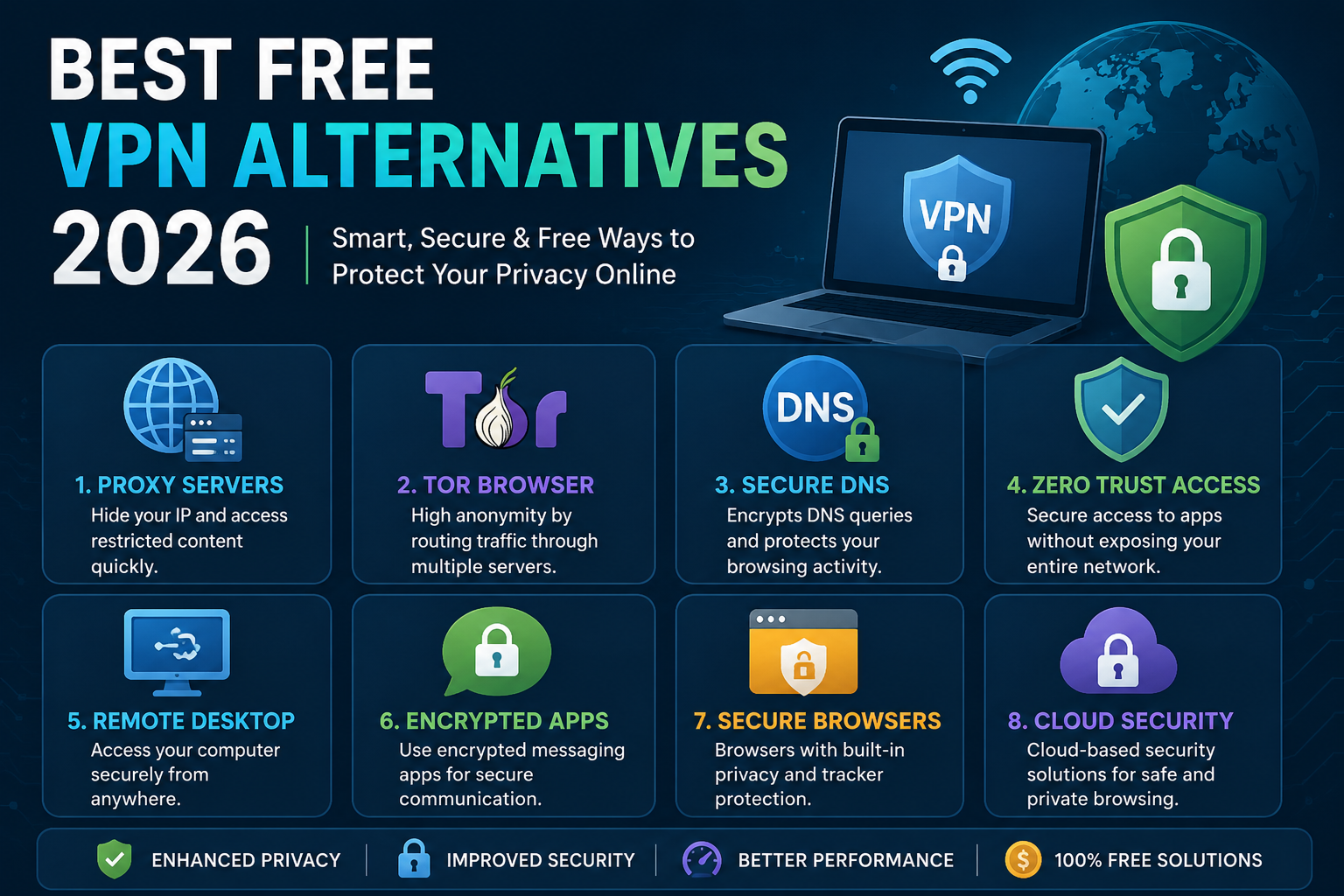
Best Free VPN Alternatives in 2026: Secure and Reliable Privacy Solutions
Online privacy has become a major concern for internet users worldwide. Whether you're browsing on public Wi-Fi, accessing geo-restricted content, or protecting sensitive data, a Virtual Private Network (VPN) is often the first solution that comes to mind. However, not everyone wants to rely on a traditional VPN service. Some users may be concerned about speed limitations, privacy policies, compatibility issues, or subscription costs.
As a result, many individuals and businesses are searching for the best free VPN alternatives that provide security, privacy, and unrestricted internet access without requiring a conventional VPN connection.
This guide explores the most effective VPN alternatives, how they work, their advantages, and which option may be best suited for your specific needs.
Why Consider VPN Alternatives?
VPNs are excellent tools for encrypting internet traffic and protecting online privacy. However, free VPN services often come with limitations such as:
- Data caps
- Reduced speeds
- Limited server locations
- Advertisements
- Privacy concerns
- Restricted features
In some situations, alternative technologies can provide similar benefits without relying on a traditional VPN service.
What Are VPN Alternatives?
VPN alternatives are tools, technologies, or services that help improve privacy, security, anonymity, or content accessibility online. While they may not offer every feature of a VPN, they often address specific needs more effectively.
Some alternatives focus on anonymity, while others prioritize secure browsing, encrypted communication, or bypassing geographic restrictions.

1. Proxy Servers
Proxy servers are among the most popular alternatives to VPNs.
A proxy acts as an intermediary between your device and the websites you visit. Instead of connecting directly to a website, your traffic passes through the proxy server first.
Benefits of Proxy Servers
- Hides your IP address
- Helps access geo-restricted content
- Faster than some VPN services
- Simple setup process
- Available for free in many cases
Limitations
- Usually does not encrypt internet traffic
- Lower security compared to VPNs
- Limited privacy protection
Proxy servers are ideal for users who mainly need location masking rather than complete encryption.
2. Tor Browser
The Tor Browser is one of the most effective privacy-focused alternatives available.
Tor routes internet traffic through multiple volunteer-operated servers, making it extremely difficult to trace online activities back to the user.
Benefits of Tor
- High level of anonymity
- Free to use
- Protects user identity
- Blocks many tracking techniques
- Suitable for privacy-conscious users
Limitations
- Slower browsing speeds
- Some websites block Tor traffic
- Not ideal for streaming or gaming
Users seeking maximum privacy often consider Tor one of the strongest alternatives to traditional VPN services.
🛡️ Claim Your VPN Protection
3. Secure DNS Services
DNS (Domain Name System) services translate website names into IP addresses.
Secure DNS providers improve privacy by encrypting DNS requests and preventing internet service providers from monitoring browsing activity.
Benefits
- Faster website loading
- Improved privacy
- Easy implementation
- Protection against DNS-based attacks
- No software installation required
Limitations
- Does not hide your IP address
- Does not encrypt all internet traffic
Secure DNS is an excellent option for users looking to enhance privacy without affecting internet speed.
4. Zero Trust Network Access (ZTNA)
Zero Trust Network Access is becoming increasingly popular among businesses and remote workers.
Rather than granting broad network access, ZTNA verifies users and devices before allowing access to specific applications.
Benefits
- Enhanced security
- Better access control
- Reduced attack surface
- Ideal for remote work environments
- Strong protection against unauthorized access
Limitations
- Primarily designed for organizations
- May require technical setup
Many cybersecurity experts view ZTNA as a modern replacement for traditional VPN infrastructure.
⬇️ Download a Trusted VPN
5. Remote Desktop Solutions
Remote desktop applications allow users to securely access another computer from anywhere.
Instead of routing all internet traffic through a VPN, users can connect directly to a trusted device.
Benefits
- Secure access to work computers
- Useful for remote employees
- Simplified file access
- Reduces network complexity
Limitations
- Not designed for anonymous browsing
- Requires host computer availability
Remote desktop software works well for professionals who need secure access to workplace resources.
6. Encrypted Messaging and Communication Apps
Many users install VPNs primarily to secure communications.
Modern encrypted messaging platforms offer strong privacy protection through end-to-end encryption.
Benefits
- Secure communication
- Protection from interception
- Free access
- Easy to use
- Available across devices
Limitations
- Protects only communication channels
- Does not secure all internet activity
These applications are ideal for individuals focused on secure conversations rather than complete internet privacy.
7. Secure Web Browsers
Privacy-focused browsers have become increasingly sophisticated.
Many include built-in features such as:
- Tracker blocking
- Ad blocking
- HTTPS enforcement
- Fingerprinting protection
- Enhanced privacy controls
Benefits
- Improved online privacy
- Faster browsing experience
- Reduced tracking
- Easy installation
Limitations
- Does not provide full traffic encryption like VPNs
A secure browser is often the simplest alternative for everyday internet users.
8. Cloud-Based Secure Access Services
Cloud security solutions now provide secure internet access without traditional VPN configurations.
These services inspect traffic, enforce security policies, and protect users regardless of location.
Benefits
- Scalable security
- Centralized management
- Improved performance
- Suitable for hybrid workplaces
Limitations
- Primarily intended for businesses
- May require subscriptions for advanced features
As cloud adoption grows, these platforms are increasingly replacing legacy VPN systems.
⭐ Find the Best VPN for You
Comparing the Best Free VPN Alternatives
| Alternative | Privacy | Security | Speed | Ease of Use |
|---|---|---|---|---|
| Proxy Server | Medium | Low | High | Easy |
| Tor Browser | Very High | High | Low | Moderate |
| Secure DNS | Medium | Medium | High | Easy |
| ZTNA | High | Very High | High | Moderate |
| Remote Desktop | Medium | High | High | Moderate |
| Encrypted Messaging Apps | High | High | High | Easy |
| Secure Browsers | Medium | Medium | High | Easy |
| Cloud Security Solutions | High | High | High | Moderate |
How to Choose the Right Alternative
The best choice depends on your goals.
For Privacy
Tor Browser remains one of the strongest options for anonymous browsing.
For Secure Communication
Encrypted messaging applications provide excellent protection for conversations.
For Business Security
ZTNA and cloud-based security platforms offer advanced protection for organizations.
For Faster Browsing
Secure DNS services and privacy-focused browsers improve security while maintaining performance.
For Remote Work
Remote desktop tools and Zero Trust solutions provide secure access to company resources.
Are Free VPN Alternatives Safe?
Most reputable alternatives are safe when obtained from trusted providers. However, users should be cautious about unknown services that promise complete privacy without transparency.
Before using any privacy tool:
- Research the provider
- Review privacy policies
- Check independent security audits
- Avoid suspicious downloads
- Keep software updated
Security ultimately depends on both the technology and how it is implemented.
The Future of VPN Alternatives
The cybersecurity landscape continues to evolve rapidly. Organizations are moving toward Zero Trust architectures, secure access service edge (SASE) frameworks, and cloud-based security models.
At the same time, consumers are becoming more aware of online privacy risks and seeking solutions that are faster, easier to use, and more transparent than traditional VPN services.
As technology advances, VPN alternatives will likely become even more powerful and accessible, offering stronger protection while maintaining convenience and performance.
Conclusion
Finding the best free VPN alternatives depends largely on your individual requirements. While VPNs remain valuable tools for privacy and security, alternatives such as proxy servers, Tor Browser, secure DNS services, Zero Trust Network Access, encrypted messaging applications, and privacy-focused browsers offer compelling solutions for different use cases.
By understanding the strengths and limitations of each option, users can choose the right privacy tool to meet their needs without relying solely on traditional VPN technology. Whether your goal is anonymous browsing, secure communication, remote work, or enhanced cybersecurity, there is an effective alternative available to help protect your digital life.

 English