
Geocells Market Forecast 2026–2036: Infrastructure Reinforcement Demand Accelerates Global Market Expansion
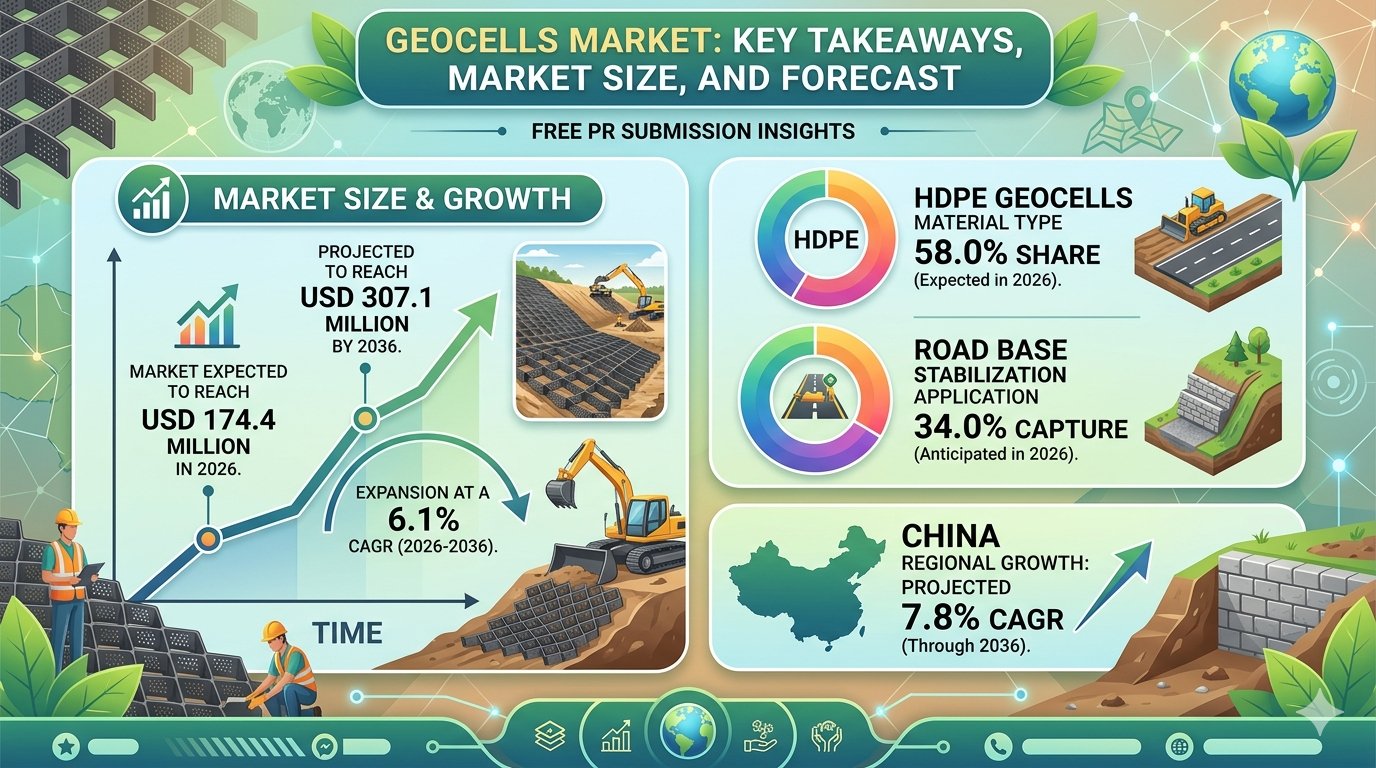
The global geocells market is projected to witness steady growth over the next decade, supported by rising infrastructure modernization projects, increasing demand for soil stabilization technologies, and growing adoption of climate-resilient construction materials. According to latest insights by Future Market Insights, the market is expected to expand from approximately USD 174.4 million in 2026 to nearly USD 307.1 million by 2036, registering a CAGR of 6.1% during the forecast period.
Market growth is being shaped by increasing deployment of geocells across transportation infrastructure, erosion control systems, railway stabilization, mining platforms, and heavy-load industrial applications. These three-dimensional cellular confinement systems are increasingly replacing traditional ground stabilization methods due to their ability to improve soil performance, reduce aggregate usage, and enhance long-term structural durability.
While HDPE geocells continue to dominate global installations because of their flexibility and cost efficiency, advanced polymer-alloy geocells are gaining traction in heavy-duty infrastructure projects requiring enhanced tensile strength and durability under extreme environmental conditions.
Geocells Market Snapshot (2026–2036)
- Market size in 2026: USD 174.4 million
- Forecast market value by 2036: USD 307.1 million
- Forecast CAGR (2026–2036): 6.1%
- Leading material segment: HDPE geocells (~58% share)
- Largest application segment: Road base stabilization (~34% share)
- Key growth markets: China, India, Saudi Arabia, United States
- Primary demand source: Transportation and infrastructure projects
- Estimated growth multiple: ~1.75x during forecast period
Momentum in the Market
Beginning from expanding adoption across civil engineering applications, the geocells market is expected to gain significant momentum throughout the forecast period as governments prioritize long-life, cost-efficient, and climate-resilient infrastructure systems.
Between 2026 and 2036, increasing investments in highways, railways, embankments, ports, mining haul roads, and flood protection systems are projected to accelerate demand for advanced ground reinforcement technologies. Geocells are increasingly being specified in infrastructure tenders because they improve load distribution, minimize soil displacement, and reduce maintenance costs over the asset lifecycle.
The market is also benefiting from growing awareness regarding engineered erosion control systems in regions prone to flooding, landslides, and slope failures caused by climate volatility.
From 2030 onward, the integration of high-performance polymer materials and sustainable geosynthetic solutions is expected to create new opportunities for geocell manufacturers operating in environmentally sensitive and high-load infrastructure sectors.
The Reasons Behind the Market’s Growth
Rising Infrastructure Development Activities
Rapid expansion of transportation infrastructure projects worldwide is significantly boosting demand for geocells in road stabilization, railway ballast reinforcement, and embankment protection applications.
Growing Need for Climate-Resilient Construction
Increasing occurrences of extreme weather events, flooding, and soil erosion are encouraging governments and engineering firms to adopt advanced soil confinement systems that improve structural resilience.
Cost-Efficient Ground Stabilization
Geocells help reduce aggregate usage while enhancing soil strength, making them an economically attractive alternative to traditional stabilization techniques.
Expanding Mining and Industrial Applications
Heavy-load industrial platforms, container yards, and mining haul roads are increasingly utilizing polymer-alloy geocells to improve load-bearing capacity and reduce maintenance frequency.
Sustainability and Material Efficiency
Geocells contribute to sustainable infrastructure development by reducing resource consumption and supporting lifecycle cost optimization strategies in civil engineering projects.
Top Segment Analysis
Material Type Analysis
HDPE Geocells Lead Market Demand
HDPE geocells account for nearly 58% of the market share due to their superior durability, chemical resistance, flexibility, and cost-effectiveness across transportation and infrastructure applications.
Polymer-alloy geocells are emerging as a fast-growing segment due to their ability to withstand extreme loads and harsh environmental conditions in industrial and mining environments.
Application Analysis
Road Base Stabilization Dominates the Market
Road base stabilization remains the largest application segment, accounting for approximately 34% of market demand. Geocells are increasingly used in highways, rural roads, and industrial access roads where weak soil conditions require improved load distribution and reduced rutting.
Other high-growth applications include:
- Slope protection
- Railway ballast reinforcement
- Mining and heavy-load platforms
- Landfill containment systems
- Erosion control infrastructure
Regional Development: Asia Pacific Emerges as Growth Engine
Asia Pacific is expected to remain the fastest-growing regional market due to large-scale transportation infrastructure expansion and increasing adoption of engineered soil stabilization technologies.
China
China is projected to register one of the highest growth rates, supported by extensive highway and railway construction across mountainous and erosion-prone regions.
India
India continues to witness rising demand due to rural road development programs, flood management initiatives, and expanding transportation infrastructure investments.
Saudi Arabia
Desert infrastructure projects and large-scale industrial developments are accelerating geocell adoption for load-bearing stabilization and soil confinement.
North America and Europe
Developed regions such as the United States, Germany, and the United Kingdom are experiencing steady demand growth driven by aging infrastructure rehabilitation and performance-based engineering standards.
Challenges, Trends, Opportunities, and Drivers
Drivers
- Increasing infrastructure modernization projects
- Rising climate-related slope failures and erosion risks
- Growing railway and highway investments
- Demand for sustainable construction materials
Opportunities
- Polymer-alloy geocell innovation
- Bio-based and sustainable geocell materials
- Smart infrastructure integration
- Expansion in mining and industrial applications
Trends
- Shift toward lifecycle cost optimization
- Increased use in railway reinforcement systems
- Growing adoption in flood-resilient infrastructure
- Integration into government infrastructure specifications
Challenges
- Limited contractor awareness in emerging markets
- Inconsistent infrastructure specification standards
- Competition from traditional stabilization techniques
- Cost sensitivity in price-driven construction projects
Country Growth Outlook
The market’s regional performance reflects varying infrastructure priorities and environmental challenges:
- China: 7.8% CAGR driven by large-scale transportation projects
- Saudi Arabia: 7.3% CAGR supported by desert infrastructure expansion
- India: 6.2% CAGR fueled by road development and soil stabilization projects
- United States: 5.8% CAGR driven by infrastructure rehabilitation
- Germany & United Kingdom: 5.6% CAGR supported by sustainability-focused engineering standards
Competitive Environment
The global geocells market remains moderately fragmented, with international geosynthetics manufacturers competing through product innovation, engineering support, and project-specific solution offerings.
Key companies operating in the market include:
- Presto Geosystems
- Strata Systems
- PRS Geo-Technologies
- Tensar
- Maccaferri
- ACE Geosynthetics
These companies are increasingly focusing on solution-based engagement models that include engineering assistance, lifecycle analysis, and project-specific performance optimization.
Future Outlook: Toward Sustainable and Resilient Infrastructure
The geocells market is entering a transformative phase driven by rising infrastructure resilience requirements, sustainability priorities, and advanced material innovation. As governments and infrastructure developers seek cost-efficient methods to improve soil performance and reduce environmental impact, geocells are expected to become increasingly important across transportation, mining, flood protection, and industrial infrastructure projects.
The evolution toward high-performance polymer-alloy geocells, bio-based materials, and climate-adaptive engineering solutions is likely to redefine the competitive landscape over the next decade.
For a comprehensive strategic analysis and detailed industry insights, readers can explore the full report on the official Future Market Insights website:
https://www.futuremarketinsights.com/reports/geocells-market

 English