
Slag Conditioner Market Set to Hit USD 3.6 Billion by 2034 at 6.2% CAGR
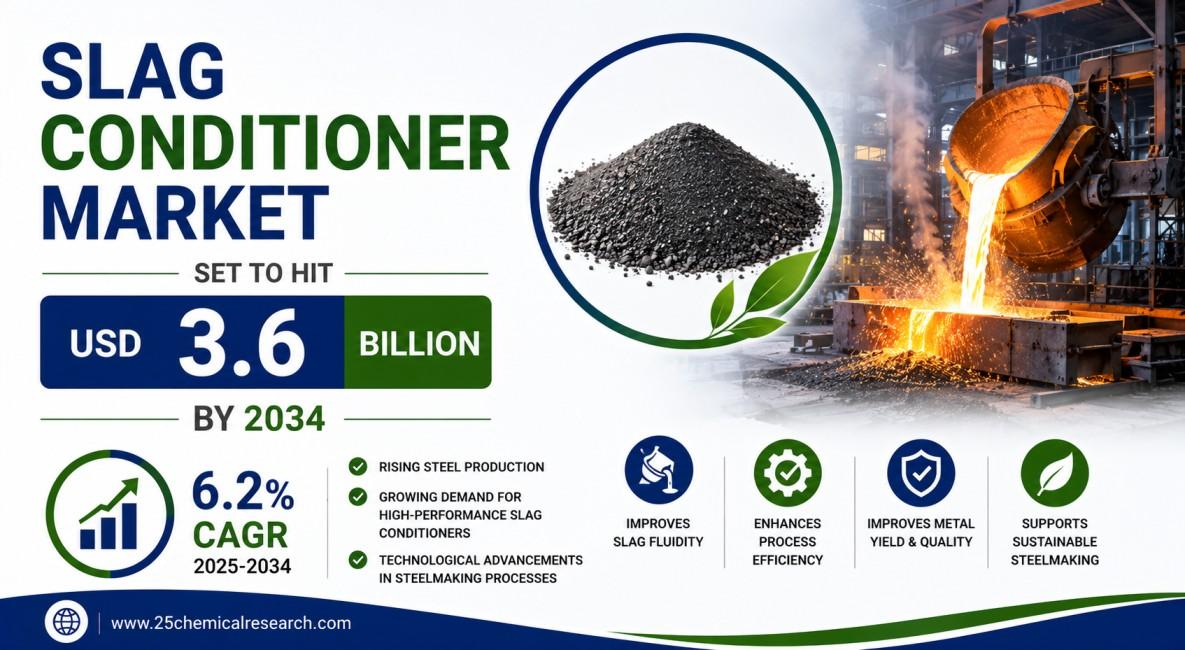
Global Slag Conditioner Market was valued at USD 2.1 billion in 2025 and is projected to reach USD 3.6 billion by 2034, exhibiting a steady CAGR of 6.2% during the forecast period.
Slag conditioners are critical additives used in steel production to optimize the chemical and physical properties of slag, such as viscosity, basicity, and melting point. These materials facilitate efficient metal-slag separation, enhance impurity removal (including desulfurization and dephosphorization), and protect refractory linings. Common slag conditioners include calcium aluminate, magnesium oxide, and fluorspar, each selected based on specific metallurgical requirements. The market's expansion is closely linked to the global steel industry's performance, especially in emerging economies, where infrastructure development and urbanization drive steel demand. Key industry participants include RHI Magnesita, Refratechnik, and TAHA International Corporation, who provide a broad range of high-performance solutions.
Get Full Report Here: https://www.24chemicalresearch.com/reports/306649/slag-conditioner-market
Market Dynamics:
The market's trajectory is shaped by a complex interplay of powerful growth drivers, significant restraints that are being actively addressed, and vast, untapped opportunities.
Powerful Market Drivers Propelling Expansion
-
Global Steel Production and Infrastructure Development: The demand for slag conditioners is intrinsically tied to steel output, which reached 1,892.4 million tonnes globally in 2023, according to the World Steel Association. As countries invest in infrastructure, construction, and manufacturing, steel production is expected to grow, particularly in Asia-Pacific and the Middle East. This expansion necessitates increased use of slag conditioners to maintain furnace efficiency, improve yield, and ensure the production of high-quality steel required for modern applications.
-
Focus on High-Quality Steel Products: Manufacturers are increasingly prioritizing the production of premium steel grades for automotive, aerospace, and heavy machinery sectors. These applications demand precise control over impurities like sulfur and phosphorus, which slag conditioners effectively manage. The shift towards electric arc furnace (EAF) steelmaking, which relies heavily on optimized slag chemistry for refining, further amplifies this demand. Efficient slag conditioning not only enhances steel quality but also reduces energy consumption and operational costs, making it indispensable for competitive steel production.
-
Operational Efficiency and Cost Reduction: Steel plants face constant pressure to improve efficiency and lower costs. Effective slag conditioning shortens tap-to-tap times, reduces refractory wear, and increases metal recovery rates. These improvements lead to significant operational savings, making slag conditioners a valuable investment. Additionally, advancements in conditioner formulations allow for better slag fluidity and reactivity, which streamline the steelmaking process and enhance overall productivity.
Download FREE Sample Report: https://www.24chemicalresearch.com/download-sample/306649/slag-conditioner-market
Significant Market Restraints Challenging Adoption
Despite its promise, the market faces hurdles that must be overcome to achieve broader adoption.
-
Volatility in Raw Material Costs: The prices of key raw materials such as bauxite, fluorspar, and dolomite are subject to significant fluctuations due to geopolitical factors, trade policies, and supply chain disruptions. These cost variations can squeeze profit margins for conditioner manufacturers and create pricing instability for end-users. Sourcing consistent, high-quality raw materials remains a challenge, impacting production planning and cost management across the industry.
-
Regulatory and Environmental Compliance: Stringent environmental regulations regarding emissions, waste handling, and workplace safety pose ongoing challenges. The use of certain slag conditioning agents requires careful management to meet health, safety, and environmental standards, potentially increasing operational complexity and costs. Compliance with regulations such as REACH in Europe adds layers of scrutiny and can delay the adoption of new or modified conditioner formulations.
Critical Market Challenges Requiring Innovation
The transition from laboratory formulations to industrial-scale application presents its own set of hurdles. Achieving consistent product quality and performance at large volumes is difficult, with variations in raw material purity and processing conditions affecting final product efficacy. Moreover, integrating slag conditioners into diverse steelmaking processes requires tailored solutions and deep metallurgical expertise, which can be a barrier for smaller players. The industry also contends with the need to balance performance with environmental sustainability, driving research into eco-friendly alternatives that do not compromise on efficiency.
Additionally, the market faces challenges related to supply chain maturity and logistics. Transporting and storing certain conditioner forms, especially powders and slurries, involves added complexity and cost compared to traditional materials. Ensuring stable supply chains amidst global economic uncertainties and fluctuating demand patterns requires robust strategic planning and partnerships.
Vast Market Opportunities on the Horizon
-
Innovation in Sustainable Solutions: There is growing interest in developing eco-friendly slag conditioners derived from industrial by-products or recycled materials. These innovations align with the steel industry's sustainability goals and can open new market segments. Formulations that reduce energy consumption, minimize waste, and enhance slag recyclability offer significant competitive advantages and are likely to see increased adoption in the coming years.
-
Expansion in Emerging Economies: Rapid industrialization and infrastructure development in regions like Asia-Pacific, particularly in India and Southeast Asia, present substantial growth opportunities. New steel plants and the modernization of existing facilities in these areas will drive demand for advanced slag conditioning products and associated technical services. Local manufacturing and strategic partnerships will be key to capturing this expanding market.
-
Value-Added Services and Digitalization: Beyond product supply, there is potential to offer integrated solutions including real-time slag analysis, process optimization services, and digital monitoring tools. These value-added services help steelmakers maximize efficiency, reduce costs, and improve product quality, fostering long-term client relationships and creating additional revenue streams for conditioner providers.
In-Depth Segment Analysis: Where is the Growth Concentrated?
By Type:
The market is segmented into Calcium Aluminate, Magnesium Oxide, Fluorspar, and others. Calcium Aluminate currently leads the market due to its superior efficiency in controlling slag basicity and fluidity, which is essential for effective desulfurization and refractory protection. Its versatility across various furnace types and steel grades makes it a preferred choice for many producers.
By Application:
Application segments include Carbon Steel, Alloy Steel, Stainless Steel, and others. The Carbon Steel segment dominates, driven by massive global demand for this material in construction, automotive, and infrastructure projects. The process of making carbon steel requires precise slag control to remove impurities and achieve desired mechanical properties, ensuring consistent quality and performance.
By End-User Industry:
The end-user landscape includes Integrated Steel Mills, Mini-Mills (EAF), and Foundries. Integrated Steel Mills are the primary consumers, as their large-scale, blast furnace-based operations involve complex slag chemistry that is critical for high-volume production. These mills require sophisticated conditioning to ensure operational efficiency, product quality, and equipment longevity.
Download FREE Sample Report:
https://www.24chemicalresearch.com/download-sample/306649/slag-conditioner-market
Competitive Landscape:
The global Slag Conditioner market is moderately concentrated and characterized by strong competition among specialized refractory and metallurgical material suppliers. The top players leverage extensive R&D capabilities, global distribution networks, and deep industry relationships to maintain their positions. Competition is based on product performance, technical support, and the ability to deliver customized solutions tailored to specific steelmaking processes. The market's growth is closely linked to the steel industry's cyclical nature, but demand for high-quality conditioners remains resilient due to their critical role in production efficiency and product quality.
List of Key Slag Conditioner Companies Profiled:
-
RHI Magnesita (Austria)
-
Refratechnik (Germany)
-
TAHA International Corporation (Saudi Arabia)
-
INTOCAST (Germany)
-
OPTA (Canada)
-
Guru Corporation (India)
-
Harsco Environmental (USA)
-
DINGRI GROUP (China)
-
Henan Shaolin Special Materials (China)
-
Zhengzhou Shengtong (China)
The competitive strategy is heavily focused on continuous R&D to enhance product efficacy and reduce costs, alongside forming strategic partnerships with steel producers to co-develop and validate application-specific solutions. This approach helps secure long-term demand and strengthens market positioning.
Regional Analysis: A Global Footprint with Distinct Leaders
-
Asia-Pacific: Is the dominant region, holding the largest market share due to robust steel production in China, India, and Japan. Rapid industrialization, urbanization, and government infrastructure investments drive demand. The region also hosts numerous local conditioner manufacturers, creating a dynamic and competitive market environment.
-
North America and Europe: These mature markets are characterized by advanced steel production technologies and a focus on high-quality, specialized steels. Demand is steady, driven by replacement needs and process optimizations rather than new capacity additions. Strict environmental regulations influence product selection and innovation trends.
-
South America, Middle East & Africa: These regions represent emerging opportunities, with growth fueled by industrial development and new steel projects. Markets are more regionalized and price-sensitive, with potential for expansion as local industries evolve and modernize.
Get Full Report Here: https://www.24chemicalresearch.com/reports/306649/slag-conditioner-market
Download FREE Sample Report: https://www.24chemicalresearch.com/download-sample/306649/slag-conditioner-market
About 24chemicalresearch
Founded in 2015, 24chemicalresearch has rapidly established itself as a leader in chemical market intelligence, serving clients including over 30 Fortune 500 companies. We provide data-driven insights through rigorous research methodologies, addressing key industry factors such as government policy, emerging technologies, and competitive landscapes.
-
Plant-level capacity tracking
-
Real-time price monitoring
-
Techno-economic feasibility studies
International: +1(332) 2424 294 | Asia: +91 9169162030

 Turkish