
What Businesses Should Ask Before Choosing a Contact Centre in the UAE
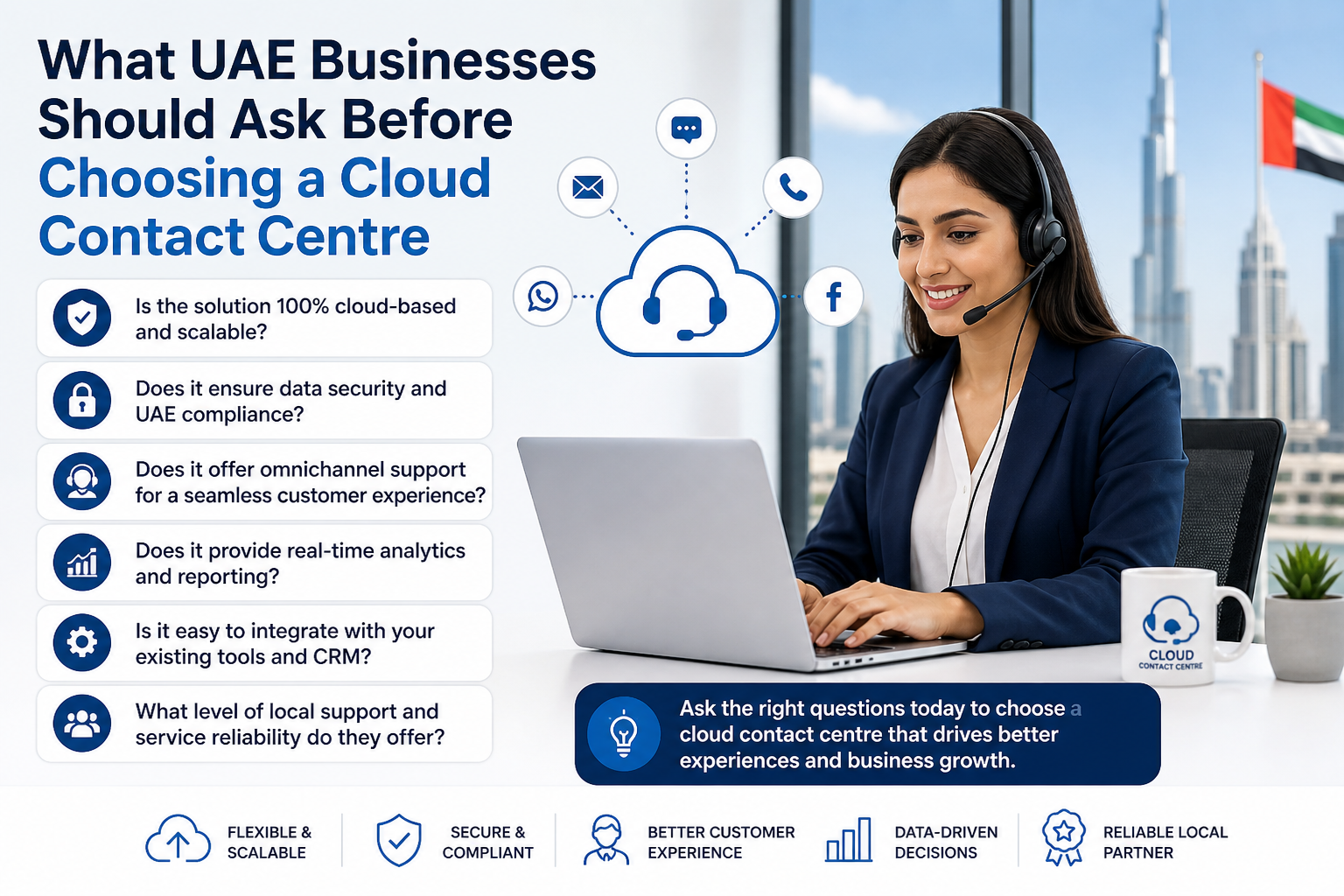
Choosing a contact centre in the UAE is no longer just a technology decision.
It is an operational decision, a customer experience decision, and in many cases, a growth decision.
Businesses want better call handling, stronger routing, clearer visibility, easier sales and support workflows, and a more modern way to manage customer communication. Many also want to explore AI voice bots, post-call analytics, CRM integration, and more flexible deployment models.
But once the buying process starts, the market can quickly feel crowded.
Many providers sound similar on the surface. Most talk about cloud calling, automation, dashboards, integrations, and AI. Pricing may look simple at first, but the real commercial picture is often more layered. Some platforms feel flexible. Others feel more rigid once rollout begins.
That is why the smartest buyers do not begin with feature checklists alone.
They begin with better questions.
If your business is evaluating contact centre software in the UAE, here are the questions you should ask before making a decision.
Why Choosing the Right Contact Centre Matters More Than Ever
For many businesses, the contact centre is no longer just a place where calls are answered.
It is where leads are captured.
It is where support quality is felt.
It is where customer issues are escalated.
It is where managers look for performance signals.
It is where voice, workflow, and customer experience come together.
That is why choosing the wrong contact centre can create problems far beyond telephony.
It can lead to:
-
missed leads
-
slow customer response
-
poor routing
-
weak visibility for managers
-
disconnected sales and support workflows
-
harder rollout than expected
-
unnecessary vendor lock-in
-
paying for features the team is not ready to use
Choosing the right contact centre, on the other hand, creates a better foundation for both operations and growth.
The First Mistake Buyers Make
One of the biggest mistakes businesses make is jumping straight to:
-
price
-
number of features
-
whether AI is mentioned
-
whether the dashboard looks modern
Those things matter, but they should not come first.
The better starting point is this:
How well will this contact centre fit the way our business actually operates in the UAE?
That question changes the whole evaluation.
Because the best contact centre software is not the one with the longest feature list.
It is the one that helps your business handle customer communication better, with less friction and more control.
1. Can We Keep Our Existing Numbers and Carrier?
This should be one of the first questions for any business already using established numbers.
Your phone numbers are already tied to your website, Google Business profile, marketing campaigns, customers, and operational workflows. Changing them unnecessarily can create disruption.
That is why businesses should ask:
-
Can we keep our current business numbers?
-
Can we continue using our existing carrier or telephony setup?
-
Does the platform support BYOC, or Bring Your Own Carrier?
-
What changes in the telecom layer, and what stays the same?
This matters because many businesses want to modernise their contact centre without rebuilding everything from scratch.
A flexible launch model can make a huge difference.
2. What Is Actually Included in the Base Platform?
Pricing pages do not always tell the full story.
A provider may show a simple monthly fee, but the actual contact centre setup may involve multiple layers such as:
-
core voice platform
-
call usage or telephony costs
-
AI voice bot modules
-
AI analytics
-
CRM integrations
-
onboarding or setup
-
premium support
-
custom workflow requirements
That is why buyers should ask:
-
What is included in the base platform?
-
What costs extra?
-
Are call recordings, dashboards, routing, and supervisor tools included?
-
Are AI features part of the same plan or separate add-ons?
-
How will pricing change as we grow?
For SMB and mid-market businesses, pricing clarity is a big part of trust.
3. How Will This Improve Our Sales and Support Workflows?
A contact centre should not be evaluated only as a calling tool.
It should be evaluated as part of how sales teams and support teams actually work.
Ask:
-
How does the platform support inbound lead handling?
-
How does it improve support queue management?
-
Can it reduce missed follow-up?
-
Will managers get better visibility into activity and outcomes?
-
Can sales and support teams work from one connected environment?
This matters because the value of a cloud contact centre comes from workflow improvement, not just call handling.
A platform that looks strong in a demo but does not fit daily operations will create more friction than progress.
4. Does It Support CRM and Helpdesk Integration?
Voice should not sit in isolation.
For many businesses in the UAE, customer communication needs to connect with the systems teams already use, such as CRM, helpdesk, ticketing, or internal workflow tools.
Businesses should ask:
-
Does the platform integrate with our CRM?
-
Can it work with support tools or ticketing systems?
-
Does it support click-to-call, activity logging, and customer context?
-
Will calls connect cleanly to our lead, account, or case workflows?
-
Can we avoid manual logging and disconnected records?
This is especially important for businesses using platforms such as Zoho CRM, Salesforce, Microsoft Dynamics, Freshworks, Bitrix24, Zendesk, or Freshdesk.
The more connected the workflow, the more useful the contact centre becomes.
5. How Strong Is the Routing and Queue Management?
Customers should not have to struggle to reach the right team.
A good contact centre should make routing smarter and more useful, not just more complex.
Ask:
-
Can calls be routed by team, language, service type, or business hours?
-
How are queues managed?
-
Can the system support overflow or priority handling?
-
Will managers have visibility into queue activity?
-
Can routing be adjusted as the team grows?
This matters because routing quality affects both customer experience and internal efficiency.
If the call reaches the wrong team, gets transferred multiple times, or waits too long in the wrong queue, service quality drops immediately.
6. Where Does AI Actually Fit?
Today, almost every provider talks about AI.
But businesses should look past the headline and ask more practical questions.
Ask:
-
Is AI voice bot capability available?
-
Is it useful for live automation, after-hours lead capture, appointment handling, or support triage?
-
Is AI analytics available for transcripts, summaries, sentiment insights, or scorecards?
-
Can we adopt AI later instead of everything on day one?
-
Does the platform support both practical automation and human handoff?
The goal should not be to buy AI because it sounds modern.
The goal should be to understand where AI will create real operational value.
For many businesses, the best approach is phased: start with core voice and add AI where it solves a real business problem.
7. What Will Rollout Actually Involve?
This is one of the most important questions, especially for SMB and mid-market teams.
Many businesses worry about rollout more than the platform itself.
That is why they should ask:
-
What does onboarding actually involve?
-
What does the provider handle?
-
What does our team need to prepare?
-
How are numbers, routing, users, and queues set up?
-
What support is available during implementation?
-
How manageable is this if we do not have a large internal IT team?
A contact centre should feel operationally achievable.
If rollout feels vague, overly technical, or heavier than expected, adoption becomes harder.
8. What Kind of Support Will We Actually Receive?
Support matters a lot more than many buyers first expect.
A platform may look strong during evaluation, but the real experience is shaped by what happens after go-live.
Ask:
-
What support model is included?
-
How quickly can we expect help when we need changes or troubleshooting?
-
Is support regional or remote-only?
-
Will we have access to guidance during rollout and after launch?
-
How are urgent issues handled?
Businesses often focus on product capability first, but support quality plays a major role in long-term success.
9. Will This Platform Still Fit as We Grow?
What works for the business today should not become a limitation tomorrow.
That is why buyers should ask:
-
Can the platform support more users as we scale?
-
Can we add new teams, use cases, or locations later?
-
Can we add integrations or analytics over time?
-
Can we introduce AI voice or post-call intelligence later?
-
Will the platform remain manageable as operations grow?
This helps businesses avoid buying too narrowly or locking themselves into a model they will outgrow too quickly.
10. Is the Provider Selling Flexibility or Lock-In?
This is a question many businesses do not ask directly enough.
Some platforms are designed around flexibility. Others are designed around a more controlled vendor environment.
Ask:
-
Can we keep our carrier?
-
Can we keep our workflows where possible?
-
Can we start with the core platform and add more later?
-
Does the provider support phased modernisation?
-
Will this make us more agile, or more dependent on one rigid setup?
For many UAE businesses, flexibility matters.
Especially when they want to improve voice operations without forcing unnecessary change across the business all at once.
A Smarter Buying Approach
Instead of comparing contact centre vendors only by feature count, businesses should evaluate them across five practical areas:
1. Voice and Routing Fit
Will this improve how customer calls are actually handled?
2. Workflow Fit
Will it support our sales, support, and operational processes?
3. Flexibility
Can we keep our numbers, carrier, and practical rollout path where needed?
4. Intelligence
Can we add AI voice or AI analytics where it creates real value?
5. Commercial Clarity
Do we clearly understand what is included, what costs extra, and how the platform scales?
This approach leads to better buying decisions.
Why This Matters for Businesses in the UAE
The UAE market has its own operational realities.
Businesses often need:
-
a more practical rollout path
-
clarity around numbers and carrier arrangements
-
strong bilingual or multi-team call handling
-
flexibility for sales and support workflows
-
clear support and onboarding
-
room to modernise without a heavy rip-and-replace project
That is why choosing a contact centre in the UAE should be more than a generic software evaluation.
It should be a business-fit evaluation.
The more grounded your questions are, the better your final decision will be.
The Bottom Line
Choosing a contact centre in the UAE should not be reduced to who has the biggest feature list or the lowest visible price.
The better decision comes from asking better questions.
Ask about numbers and carrier flexibility.
Ask about pricing clarity.
Ask about rollout.
Ask about CRM and helpdesk integration.
Ask how AI fits.
Ask how the platform improves real workflows for sales and support teams.
That is how businesses move from generic software comparison to a more confident buying decision.
And that is how they choose a contact centre that fits the way they actually operate.
Ready to Explore What the Right Contact Centre Setup Could Look Like for Your Business?
Voiger helps businesses modernise customer communication with practical cloud contact centre workflows, flexible deployment options, AI-ready capabilities, and a rollout model designed for real business needs.
If your team is evaluating contact centre software in the UAE, book a demo with Voiger to explore a setup that fits your operations more clearly.
FAQ's
What should businesses ask before choosing a contact centre in the UAE?
They should ask about pricing, BYOC support, number continuity, routing, integrations, AI capabilities, rollout effort, support quality, and how well the platform fits their sales and support workflows.
Why is BYOC important when choosing a cloud contact centre?
BYOC, or Bring Your Own Carrier, helps businesses keep existing carrier relationships and often reduce migration friction when moving to a cloud contact centre.
Should businesses focus only on price when comparing contact centre software?
No. The visible price is only one part of the decision. Businesses should also understand what is included, what costs extra, and how the platform fits their real workflows and growth plans.
Why do CRM and helpdesk integrations matter?
They help connect calling with customer records, lead workflows, support tickets, and internal processes so teams can work with better context and less manual effort.
How should businesses think about AI when choosing a contact centre?
They should ask where AI creates practical value, such as AI voice bots for automation or AI analytics for summaries and sentiment insights, rather than treating AI as only a marketing term.
What should SMB and mid-market businesses prioritise?
They should prioritise practical rollout, pricing clarity, flexibility, workflow fit, support quality, and the ability to adopt more advanced capabilities over time.
Is rollout usually a major technical project?
Not always. It depends on the provider and deployment model. Businesses should ask clearly what the provider will handle, what their team needs to do, and how manageable the rollout will be.
Why does choosing the right contact centre matter so much?
Because the contact centre affects lead response, customer support, team productivity, manager visibility, and the overall customer experience. It is an operational decision, not just a telephony decision.

 Turkish