
Industrial Robotics Market to Surpass USD 343.8 billion by 2036
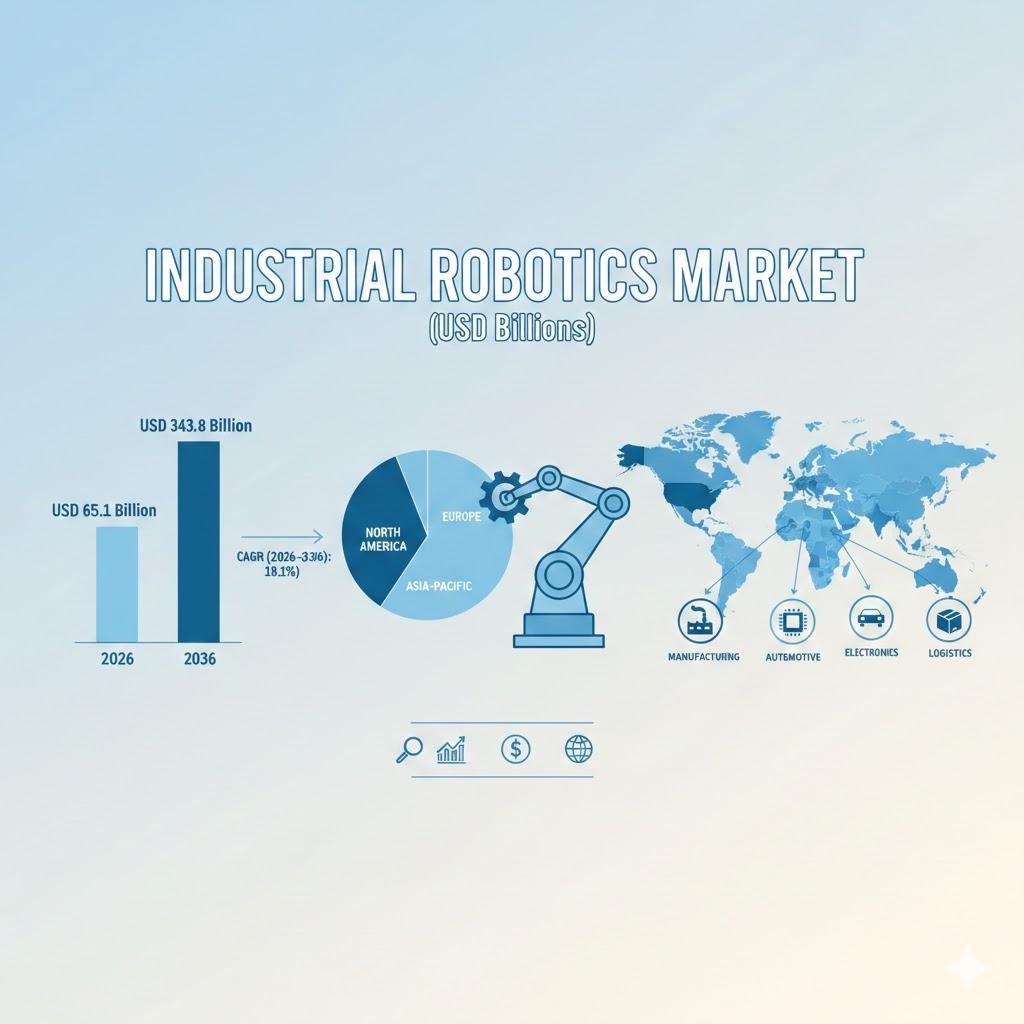
The global Industrial Robotics Market is projected to grow from USD 65.1 billion in 2026 to USD 343.8 billion by 2036, expanding at a CAGR of 18.1%, according to Future Market Insights (FMI). The surge reflects a structural transformation in manufacturing, where automation, artificial intelligence (AI), and smart factory investments are becoming essential rather than optional.
According to the World Robotics 2024 report published by the International Federation of Robotics (IFR), global robot installations surpassed 590,000 units in 2023, reflecting sustained momentum across manufacturing and industrial sectors. Growth continues to be driven by the rapid adoption of collaborative robots (cobots) and AI-enabled vision technologies, which are enhancing precision, flexibility, and human-machine collaboration. This upward trajectory is prompting robot OEMs to accelerate investments in hardware miniaturization, advanced sensing capabilities, and intelligent software platforms.
Request For Sample Report | Customize Report | Purchase Full Report –
https://www.futuremarketinsights.com/reports/sample/rep-gb-285
Market at a Glance: Key Data Points
- Market Size (2026): USD 65.1 Billion
- Projected Market Value (2036): USD 343.8 Billion
- CAGR (2026–2036): 18.1%
- Global Installations (2023): 590,000+ industrial robots (IFR)
- Fastest-Growing Segment: Collaborative Robots (Cobots)
FMI’s proprietary forecasting model integrates IFR robot installation data, factory automation capital expenditure trends, and country-level manufacturing investments to derive long-term projections.
AI and Vision Systems Reshaping Competitive Dynamics
The International Federation of Robotics (IFR) confirmed that global installations exceeded 590,000 units in 2023, underlining sustained automation momentum. However, FMI analysts emphasize that growth is no longer purely volume-driven—it is intelligence-driven.
Industrial robots are evolving from fixed, programmable machines into adaptive, AI-enabled systems powered by:
- Vision-guided manipulation
- Real-time process analytics
- Predictive maintenance algorithms
- Edge AI processing
- Integration of large language models (LLMs) for natural-language instruction
The market is steadily transitioning from mechanical differentiation to software-based competitive advantage.
ABB Spin-Off Signals Market Maturity
In July 2025, ABB announced plans to spin off its Robotics and Discrete Automation division into a standalone publicly listed entity by Q2 2026. This move is widely interpreted as confirmation that industrial robotics has matured into a high-growth, capital-intensive vertical demanding dedicated strategic focus.
FMI opines that similar restructuring initiatives may emerge across diversified industrial groups, further consolidating robotics as a standalone global industry pillar.
Segment Outlook: Articulated Robots and Cobots Lead Growth
- Articulated Robots
Articulated robots remain dominant across automotive, aerospace, electronics, and metal fabrication sectors due to:
- Multi-axis flexibility
- High payload capacity
- Precision welding and assembly capability
- Reduced cycle times and defect rates
AI-enhanced articulated systems now incorporate motion optimization, torque control, and digital twin simulation to improve uptime and efficiency.
- Collaborative Robots (Cobots)
Cobots represent the fastest-growing category, expanding across SMEs, food processing, electronics, and pharmaceutical manufacturing.
Key growth drivers include:
- Built-in force sensors and safety systems
- Simplified programming interfaces
- Lower deployment cost
- Human-robot collaboration capabilities
Cobots are increasingly deployed in logistics, packaging, laboratory automation, and warehouse fulfillment centers.
Application Growth: Assembly and Welding Drive Revenue
Assembly & Disassembly
Robotic assembly systems are expanding rapidly in electronics and automotive manufacturing. AI-enabled vision systems support:
- Autonomous part placement
- Adaptive alignment correction
- Reduced takt time
- Higher throughput efficiency
Electronics manufacturing, particularly semiconductor and PCB assembly, benefits from micro-precision robotics that reduce tolerances and defects.
Welding Applications
Robotic welding adoption is strong in automotive and heavy equipment manufacturing due to:
- Consistent bead placement
- Reduced spatter and rework
- Improved metallurgical integrity
- Faster production cycles
Advanced seam tracking and AI-based arc control systems are elevating welding precision and safety standards.
Regional Analysis: Asia-Pacific Maintains Leadership
Asia-Pacific
- Largest installation base globally
- Strong government-backed manufacturing modernization
- Dominant presence in automotive and semiconductor sectors
- High adoption in China, Japan, and South Korea
North America
- Strong smart manufacturing initiatives
- AI integration in automotive and logistics
- Expansion of robotics in e-commerce fulfillment
Europe
- Focus on energy-efficient robotic systems
- Alignment with EU sustainability and digitalization mandates
- Growing adoption in warehouse automation
Country-level growth projections (2026–2036):
- South Korea: 18.1% CAGR
- European Union: 18.0% CAGR
- Japan: 17.8% CAGR
- United States: 17.6% CAGR
- United Kingdom: 17.1% CAGR
Competitive Landscape: Software Intelligence Defines Leadership
Key market participants include:
- Fanuc Corporation
- ABB Ltd.
- Yaskawa Electric Corporation
- KUKA AG (Midea Group)
- Mitsubishi Electric Corporation
Collectively, leading players are investing in:
- AI-driven robotics
- Smart factory platforms
- Robot-as-a-Service (RaaS) models
- Cybersecure industrial networks
FMI highlights that future differentiation will rely more on AI capabilities, adaptive learning, and integrated analytics rather than purely mechanical specifications.
Challenges and Emerging Opportunities
Challenges
- High upfront capital investment
- Integration complexity with legacy systems
- Skilled workforce training requirements
Opportunities
- Growth of cobots in labor-intensive industries
- AI-driven intelligent automation
- Expansion into healthcare, agriculture, and logistics
- Subscription-based robotics deployment models

 Turkish