
What standards must a IVF Lab Design Company follow?
INTRODUCTION
The rapid growth of assisted reproductive technologies has made it essential for every IVF Lab Design Company to follow strict standards and guidelines. A well-designed laboratory is not just about infrastructure—it is about creating a highly controlled, sterile, and efficient environment that supports successful fertility treatments. A professional IVF Lab Design Consultant ensures that every aspect of the lab meets national and international standards to guarantee safety, quality, and reliability.
In this blog, we will explore the key standards that IVF lab design companies must follow and why compliance is critical for achieving optimal outcomes.
Why Standards Matter in IVF Lab Design
IVF laboratories handle extremely sensitive biological materials such as gametes and embryos. Any deviation from standards can lead to:
- Contamination risks
- Reduced success rates
- Equipment malfunction
- Regulatory issues
Following proper standards ensures:
- Patient safety
- Consistent lab performance
- Higher success rates
- Legal compliance
Key Standards for IVF Lab Design Company
1. ICMR Guidelines (India)
In India, IVF labs must comply with guidelines set by the Indian Council of Medical Research (ICMR).
Key Requirements:
- Proper lab layout and zoning
- Qualified staff
- Ethical practices
- Equipment standards
2. NABL Accreditation Standards
The National Accreditation Board for Testing and Calibration Laboratories (NABL) ensures quality and reliability.
Focus Areas:
- Laboratory competence
- Quality management systems
- Documentation and record-keeping
3. ISO Cleanroom Standards
Cleanroom standards are essential for maintaining air quality.
Includes:
- ISO 14644 classification
- Controlled particle count
- Air filtration systems
4. ASHRAE Guidelines
ASHRAE standards guide HVAC system design.
Key Aspects:
- Temperature control
- Humidity regulation
- Airflow design
5. WHO Laboratory Guidelines
World Health Organization (WHO) guidelines ensure global best practices.
Focus Areas:
- Safety protocols
- Laboratory design
- Infection control
6. ESHRE Guidelines (European Society of Human Reproduction and Embryology)
ESHRE provides internationally recognized standards.
Includes:
- Embryology lab practices
- Equipment requirements
- Quality control
Cleanroom and Air Quality Standards
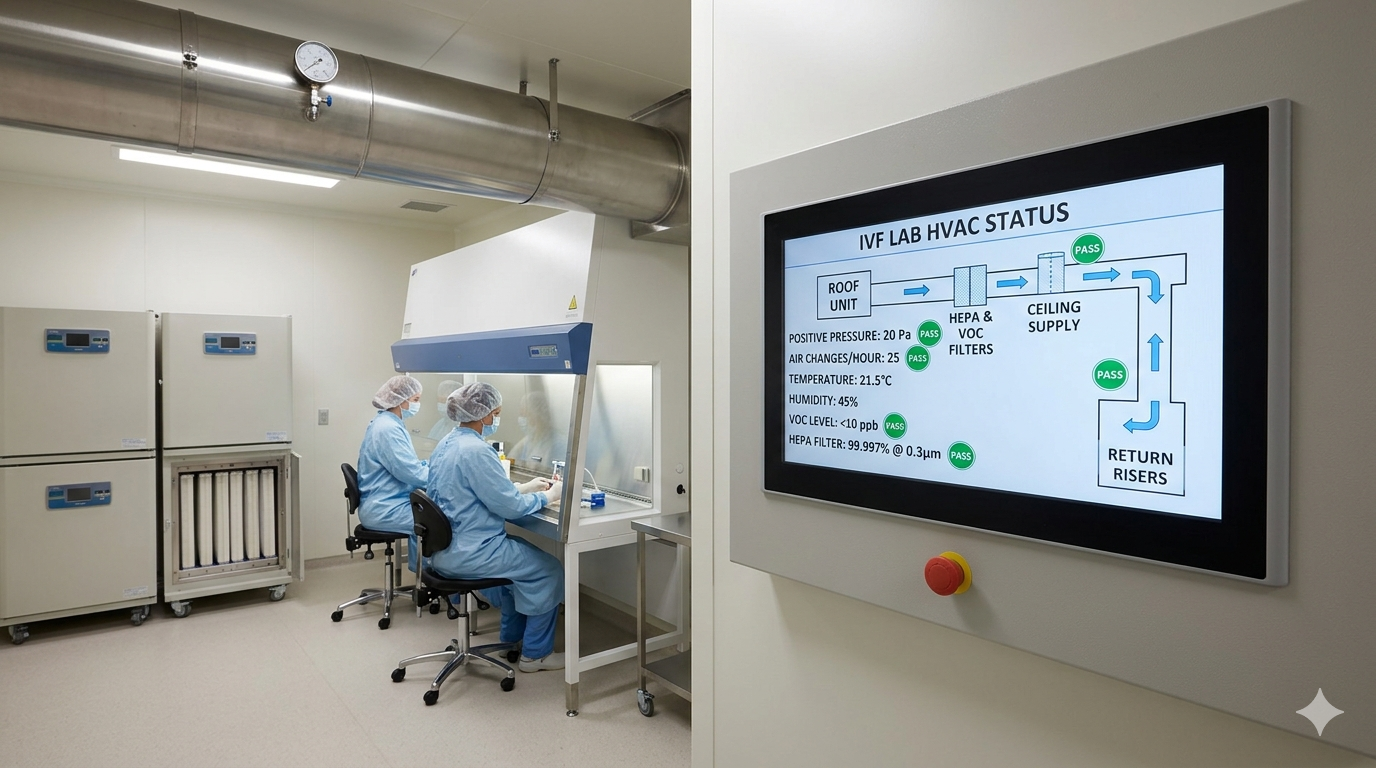
Air quality is a critical factor in IVF labs.
Requirements:
- HEPA filtration
- Laminar airflow
- VOC control systems
- Positive pressure environments
HVAC System Standards
HVAC systems must meet strict criteria:
- Temperature: 20–24°C
- Humidity: 40–60%
- Adequate air changes per hour
Equipment Standards
An IVF Lab Design Consultant ensures:
- Use of certified equipment
- Regular calibration
- Compatibility with cleanroom conditions
Material and Construction Standards
Materials used in IVF labs must:
- Be non-toxic
- Have low VOC emissions
- Be easy to clean and maintain
Zoning and Layout Standards
Proper zoning is essential for contamination control.
Zones include:
- Entry and changing areas
- Preparation rooms
- Embryology lab
- Cryopreservation area
Infection Control Standards
Strict infection control measures include:
- Sterilization protocols
- Controlled access
- Protective clothing
Documentation and Quality Control
Maintaining records is essential:
- Equipment logs
- Maintenance schedules
- Quality control reports
Safety Standards
Safety measures include:
- Fire safety systems
- Emergency exits
- Electrical safety
Environmental Monitoring Standards
Continuous monitoring ensures compliance:
- Air quality sensors
- Temperature and humidity monitoring
- Alarm systems
Ethical and Legal Standards
IVF labs must follow:
- Ethical guidelines for patient care
- Legal regulations for reproductive technologies
Challenges in Meeting Standards
Some challenges include:
- High compliance costs
- Need for skilled professionals
- Regular audits and inspections
Benefits of Following Standards
Compliance ensures:
- Improved success rates
- Enhanced patient trust
- Long-term reliability
- Regulatory approval
Role of IVF Lab Design Consultant
A professional IVF Lab Design Consultant helps by:
- Ensuring compliance with standards
- Designing efficient layouts
- Integrating advanced technologies
Future Trends in IVF Lab Standards
The future includes:
- AI-based monitoring systems
- Smart cleanroom technologies
- Advanced quality control systems
Why Choose a Professional IVF Lab Design Company
An experienced IVF Lab Design Company provides:
- Expertise in regulatory compliance
- Customized solutions
- Reliable performance
Conclusion
Adhering to strict standards is essential for any IVF Lab Design Company to ensure safety, efficiency, and successful outcomes. From ICMR and NABL guidelines to ISO cleanroom standards and HVAC requirements, every aspect of IVF lab design must meet established norms. A skilled IVF Lab Design Consultant plays a crucial role in achieving compliance and optimizing lab performance. Altus Airflow delivers advanced and reliable solutions tailored to meet the highest standards in IVF laboratory design.
FAQs
1. What standards must an IVF Lab Design Company follow?
An IVF Lab Design Company must follow ICMR, NABL, ISO, ASHRAE, and WHO guidelines to ensure quality and safety.
2. Why is ISO certification important for IVF labs?
ISO standards ensure proper air quality, cleanroom conditions, and overall lab performance.
3. What role does an IVF Lab Design Consultant play?
An IVF Lab Design Consultant ensures compliance with standards, proper layout planning, and efficient system integration.
4. How do HVAC standards affect IVF labs?
HVAC standards maintain temperature, humidity, and air quality, which are critical for embryo development.
5. What happens if IVF labs do not follow standards?
Failure to follow standards can lead to contamination, reduced success rates, and regulatory issues.
Read Our Previous Blog------>What are the design requirements for a IVF Lab Design In India?

 English