
What is an Intelligent Agent in AI? Types, Examples, and Business Applications
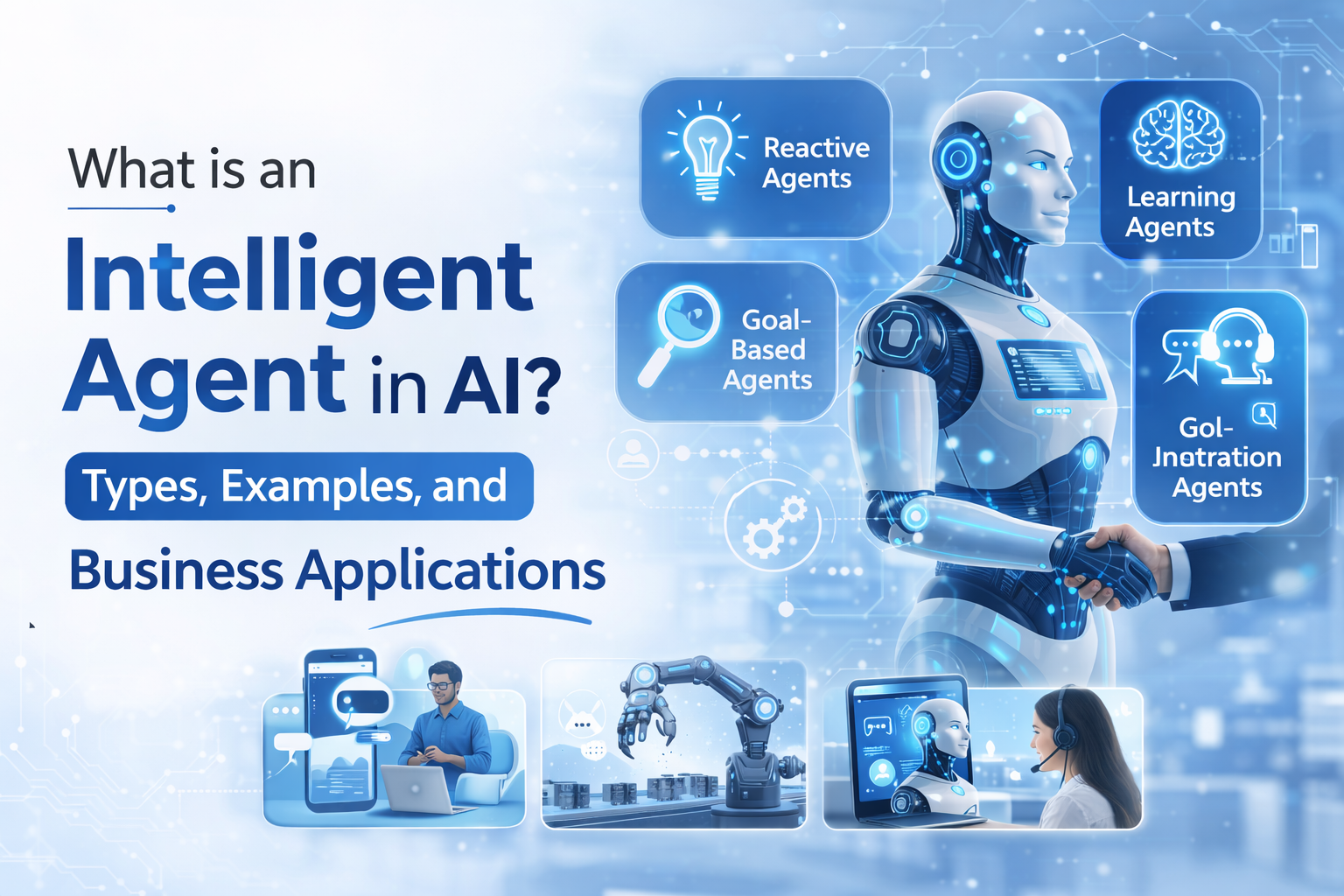
Artificial intelligence continues to influence how businesses operate, automate processes, and interact with customers. One important concept in artificial intelligence is the intelligent agent. These systems are designed to observe their environment, process information, and take actions that help achieve specific goals.
Intelligent agents are widely used in automation systems, recommendation engines, customer support platforms, and enterprise software. As organizations adopt AI-driven technologies, understanding how intelligent agents work can help decision-makers identify practical applications for business operations.
This guide explains what an intelligent agent in AI is, the different types of agents, real-world examples, and how businesses use them to improve efficiency and customer experience.
What is an Intelligent Agent in AI?
An intelligent agent is a software system that perceives its environment through data inputs, analyzes that information, and performs actions to achieve a specific objective.
The key idea behind an intelligent agent is decision-making based on available information. Instead of relying solely on fixed instructions, intelligent agents can evaluate conditions and determine the most appropriate action.
For example, a customer support system may receive a user question, analyze the request, and either provide an automated answer or route the conversation to a human support agent.
Many modern communication platforms such as Voiger integrate AI-based agents to help businesses automate customer interactions and manage communication more efficiently.
Key Characteristics of Intelligent Agents
Intelligent agents generally share several core characteristics that enable them to function effectively.
Autonomy
They can operate with minimal human intervention once configured.
Perception
Agents collect information from their environment through inputs such as user messages, sensors, or data streams.
Decision-making
After analyzing data, the system determines the best possible action to achieve its objective.
Adaptability
Some intelligent agents can learn from data and improve performance over time.
These characteristics allow intelligent agents to manage tasks that would otherwise require continuous human involvement.
How Intelligent Agents Work
An intelligent agent follows a structured cycle of interaction with its environment.
First, the agent receives information from the environment. This information may come from user input, databases, system events, or communication channels.
Second, the agent processes the information using algorithms, rules, or machine learning models. This step allows the system to understand the situation and determine the most relevant action.
Finally, the agent performs an action based on the decision. The action could involve sending a message, updating a record, triggering a workflow, or responding to a user request.
This cycle repeats continuously as new data becomes available.
Types of Intelligent Agents in AI
Artificial intelligence research categorizes intelligent agents into several types based on how they process information and make decisions.
Simple Reflex Agents
Simple reflex agents respond to specific conditions using predefined rules. When a certain input is detected, the system performs a specific action.
For example, a basic chatbot may respond with a predefined message when a customer asks about pricing or working hours.
These agents are effective for straightforward tasks but are limited when dealing with complex scenarios.
Model-Based Agents
Model-based agents maintain an internal representation of the environment. This allows them to consider the current situation and past interactions before making decisions.
By maintaining context, these agents provide more accurate responses compared to simple rule-based systems.
Goal-Based Agents
Goal-based agents evaluate potential actions and choose the one that best supports a defined objective.
For instance, a support automation system may route customer inquiries in a way that reduces waiting time or improves service quality.
Goal-based agents often require more advanced reasoning capabilities than simple reflex agents.
Utility-Based Agents
Utility-based agents measure the value of different outcomes and select actions that maximize the desired result.
These agents are commonly used in recommendation systems, pricing optimization, and decision-support tools.
Learning Agents
Learning agents improve their behavior over time by analyzing data and feedback. Machine learning techniques allow these agents to refine their decision-making process based on previous outcomes.
As more data becomes available, learning agents become more accurate and effective.
Examples of Intelligent Agents
Intelligent agents are already used in many digital systems and business platforms.
Virtual assistants such as Amazon Alexa or Google Assistant process voice commands and perform actions like retrieving information or controlling smart devices.
Customer support chatbots respond to frequently asked questions and assist users with service requests.
Recommendation systems analyze user behavior and suggest products, movies, or content based on preferences.
Autonomous navigation systems used in vehicles analyze surroundings and make driving decisions based on real-time data.
These examples show how intelligent agents can operate in different environments and perform a wide range of tasks.
Business Applications of Intelligent Agents
Businesses are increasingly implementing intelligent agents to automate operations and improve productivity.
Customer Support Automation
Customer support is one of the most common applications of intelligent agents. AI systems can respond to frequently asked questions, guide customers through troubleshooting steps, and escalate complex issues when needed.
Companies that provide cloud communication platforms often integrate AI agents to manage high volumes of customer interactions efficiently.
Sales and Lead Management
Intelligent agents help sales teams manage incoming leads by qualifying prospects, collecting basic information, and scheduling meetings.
Automation reduces manual workload and allows sales professionals to focus on high-value conversations with potential clients.
Workflow Automation
Organizations use intelligent agents to automate repetitive internal processes such as document processing, data entry, and report generation.
Automation improves operational efficiency and reduces the likelihood of human error.
Data Monitoring and Analysis
Intelligent agents can analyze large datasets and detect patterns or anomalies. Businesses use these insights to monitor system performance, identify customer trends, and support strategic decisions.
Communication Platforms
Modern communication systems increasingly use intelligent agents to manage call routing, message responses, and service requests.
Platforms such as Voiger incorporate automation tools that help businesses manage customer interactions while maintaining efficiency.
Benefits of Intelligent Agents for Businesses
Organizations that implement intelligent agents often experience measurable improvements in efficiency and service quality.
Automation reduces the time required to complete routine tasks. Systems can operate continuously without interruption, which increases productivity.
Response times also improve because automated agents can process requests immediately. This is particularly useful for customer support teams that handle large volumes of inquiries.
Another advantage is scalability. Businesses can expand automation systems as demand increases without significantly increasing operational costs.
Consistency is also improved because intelligent agents follow defined processes and rules when performing tasks.
Challenges of Using Intelligent Agents
Despite their advantages, intelligent agents also present challenges that businesses should consider.
Implementation often requires high-quality data and careful system configuration. If the underlying data is inaccurate or incomplete, the system may produce incorrect results.
Integration with existing software systems may also require technical planning. Businesses often need to connect intelligent agents with databases, CRM systems, and communication platforms.
Another consideration is human oversight. Some situations require judgment, empathy, or negotiation that automated systems cannot fully replicate.
For this reason, many organizations combine intelligent agents with human teams to maintain balanced operations.
Frequently Asked Questions
What is the difference between an AI agent and an intelligent agent?
An AI agent is a general term for systems that perform tasks using artificial intelligence. An intelligent agent specifically refers to systems that perceive their environment and make decisions to achieve goals.
Where are intelligent agents used?
They are commonly used in customer support systems, virtual assistants, recommendation engines, automation platforms, and data analysis tools.
Do intelligent agents learn automatically?
Some intelligent agents use machine learning and can improve over time. Others operate using predefined rules and do not learn from data.
Are intelligent agents expensive to implement?
Costs vary depending on the complexity of the system. Many cloud-based platforms now provide AI tools that allow businesses to implement intelligent agents without large infrastructure investments.
Can intelligent agents replace human workers?
Intelligent agents usually assist employees rather than replace them. They automate repetitive tasks while humans focus on complex decision-making and strategic work.
Conclusion
Intelligent agents play a major role in modern artificial intelligence systems. By observing their environment, processing information, and taking actions to achieve defined goals, these systems help automate many types of business operations.
From customer support automation to data analysis and workflow management, intelligent agents support organizations in improving efficiency and reducing operational workload.
As AI technologies continue to evolve, businesses are likely to rely more on intelligent agents to manage communication systems, analyze data, and support decision-making processes. Platforms such as Voiger demonstrate how AI-based automation can assist companies in managing customer interactions and operational tasks in a scalable way.

 English