
Comparing Immersive Stories with Spoken Word Formats
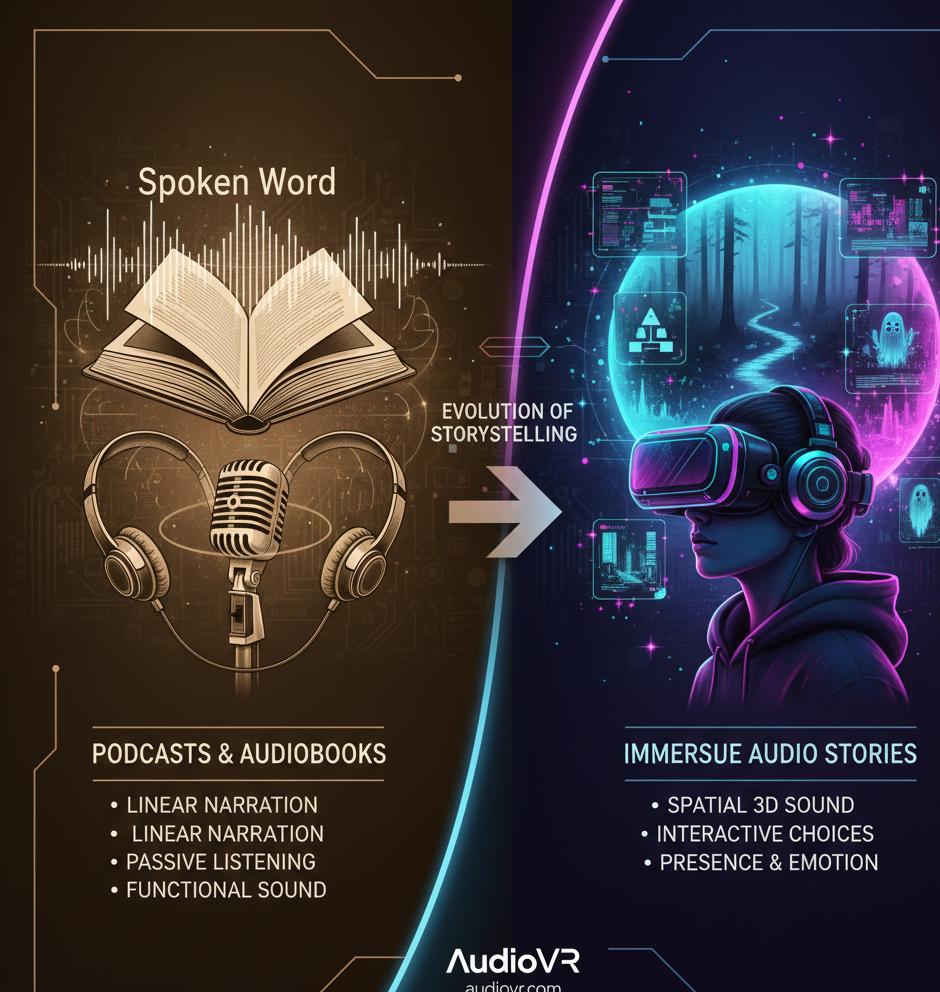
Comparing Immersive Stories with Spoken Word Formats
In the world of audio entertainment and storytelling, traditional formats like podcasts and audiobooks have long been the go-to methods for sharing narratives. They captivate through voice, pacing, and performance — but a newer form of audio experience is rising that goes beyond linear narration. Immersive audio stories take listeners into the world of the narrative, not just through it. This shift represents a major evolution in how we engage with stories through sound. Platforms like AudioVR are leading the charge by blending cinematic audio techniques, spatial sound design, and interactivity to redefine listening experiences. mmersive audio storytelling and spoken word formats — and why this evolution matters to both creators and listeners.
🎧 What Are Spoken Word Audio Formats?
Spoken word audio formats include:
-
Podcasts – typically conversational or narrative series ranging from factual storytelling to interviews.
-
Audiobooks – narrated readings of written texts, often performing multiple characters or styles.
These formats rely heavily on narration and range in production complexity from simple voice recordings to highly produced performances with music and effects. They are linear — listeners hear the story as it was recorded from beginning to end.
🔊 What Are Immersive Audio Stories?
Immersive audio stories use 3D soundscapes, spatialized audio positioning, and sometimes interactive choices to create an experience that feels like a world you can step into. Instead of passively hearing dialogue or narration, listeners are placed inside rich sonic environments where sound moves around them and scenes are shaped through sound design. This makes each experience feel more like an adventure or a virtual environment than a traditional audio track.
1. Experience vs. Listening: Presence vs. Observation
One of the biggest differences between immersive audio stories and spoken word formats is the sense of presence.
-
Spoken Word: Listeners are observers. They listen to someone else tell a story.
-
Immersive Audio: Listeners feel present in the story universe. Sound comes from all directions, creating the psychological sensation that you are inside the scene.
This shift from observation to presence changes how stories are processed emotionally and cognitively. In immersive formats, ambient sound and directional audio help the brain interpret depth and space — making the experience feel real, even without visuals. (researchgate.net)
2. Linear vs. Branching Narrative Structure
Traditional spoken audio typically follows a fixed narrative path defined by the narrator or author. You listen from start to finish in the order intended.
Immersive audio often supports branching narratives — meaning the story can change based on the listener’s choices. For example:
-
Do you follow Character A or Character B?
-
Do you investigate the sound in the alley or continue forward?
Each decision can lead to a different path and possibly even different endings. This level of interactivity increases engagement and makes listeners feel like participants, not just consumers of a story.
3. Sound Design: Functional vs. Experiential
Spoken word productions may include music and sound effects, but these elements usually complement the narration. They add atmosphere, tension, or emphasis — but the story still lives in the words themselves.
Immersive audio uses cinematic sound design where audio elements do more than support narration; they create the world.
-
Ambient soundscapes give environment context (e.g., city noise, ocean waves).
-
Spatial audio positioning places sound in 3D space around the listener.
-
Dynamic audio effects change based on movement and choice.
In immersive formats, sound isn’t just decorative — it’s interactive and contextually informative.
4. Cognitive Engagement and Memory
Spoken word storytelling connects primarily through narrative flow and voice performance. However, immersive audio stories engage additional cognitive pathways by stimulating spatial awareness and emotional processing.
When sound mimics real-world acoustics and movement — as in immersive audio — the listener’s brain interprets the experience as situated rather than retold. This shift enhances:
-
Attention and focus
-
Emotional involvement
-
Memory encoding of narrative moments
Research in spatial audio shows that sound can influence psychological presence — the feeling that you are “in” the story world — even when visuals are absent. This increased presence tends to improve recall and emotional resonance compared with traditional narration alone. (researchgate.net)
5. Replay Value and Personalization
Because spoken word formats are linear, each listen delivers the same experience — unless the narrator adapts performance or the listener chooses a different title.
Immersive audio stories often offer multiple listening experiences within the same title. Branching paths, choice-driven moments, and dynamic soundscapes encourage listeners to return, explore alternative choices, and uncover new aspects of the narrative. In this way, immersive audio enhances replay value and personalizes the experience.
6. Formats and Accessibility
Spoken word formats enjoy broad accessibility since they require minimal hardware — typically just playback devices like phones or speakers. They’re perfect for multitasking, commuting, or learning.
Immersive audio, on the other hand, thrives with headphone use and spatial sound support. While this environment adds complexity, it also unlocks deeper sensory engagement, making immersive formats ideal for intentional listening where emotional and contextual experience matters most.
Conclusion
At their core, both immersive audio stories and spoken word formats aim to connect listeners with narrative meaning — but they do so in different ways. Spoken word relies on voice, pacing, and content structure, while immersive audio expands storytelling into space and interaction.
Immersive audio doesn’t replace traditional formats — instead, it expands possibilities for how we experience sound. For listeners who seek deeper presence, emotional connection, and interactive engagement, immersive stories offer a captivating alternative that turns audio into a world you can step into, not just listen to.

 English