
How Are Monoblock Forged Wheels Manufactured?
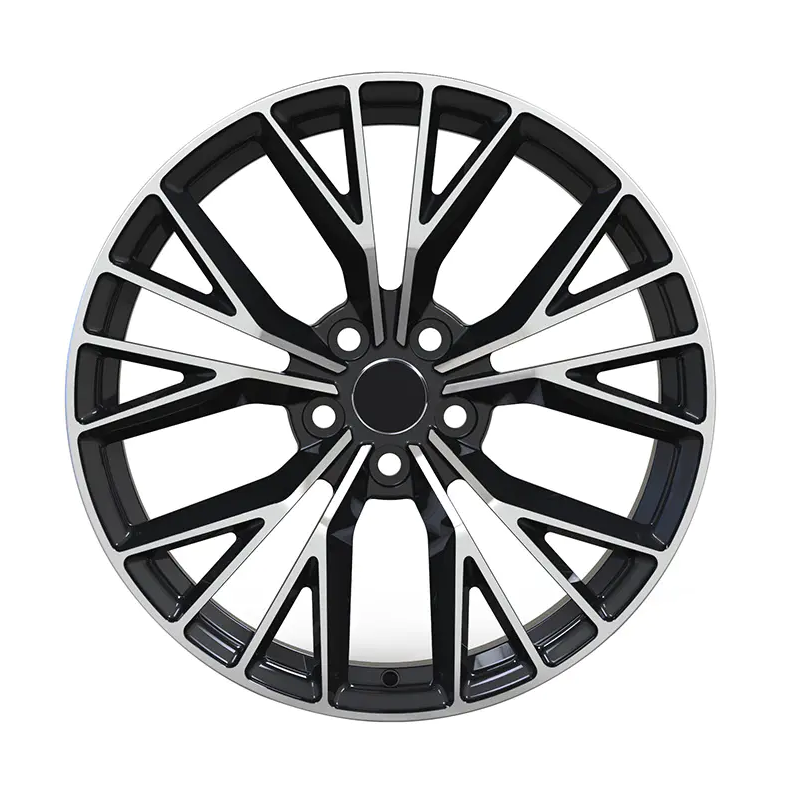
The production of a Monoblock Forged Wheel involves a sequence of controlled metallurgical and machining processes designed to transform raw aluminum into a high-strength structural component. Unlike multi-piece assemblies, the monoblock approach relies on a single billet, eliminating joints and mechanical fasteners.
The process begins with selection of aluminum alloy, commonly 6061-T6. This alloy contains magnesium and silicon as primary strengthening elements, offering a favorable combination of machinability and mechanical resilience. Prior to forging, billets undergo homogenization heat treatment to stabilize internal composition.
Forging is performed using hydraulic presses capable of exerting forces between 8,000 and 15,000 tons. The billet is placed into a precision die and compressed into a rough wheel shape. During this stage, plastic deformation occurs, and the internal grain structure begins to realign according to applied stress direction.
This grain alignment is a key differentiator in Monoblock Forged Wheel engineering. Instead of random grain distribution found in cast products, forged aluminum develops directional flow lines that follow structural load paths. These flow lines increase fatigue resistance and improve tensile strength under dynamic stress conditions.
After forging, the component undergoes a multi-stage CNC machining process. High-speed 5-axis machines remove excess material and refine geometry with tolerances often within ±0.02–0.05 mm. This step defines critical features such as hub bore diameter, bolt pattern accuracy, and spoke contour precision.
A typical forged wheel blank may lose 50%–70% of its initial forged mass during machining. Material removal is intentional, focusing only on non-load-bearing sections while preserving structural load paths identified through simulation models.
Heat treatment follows machining in many production systems. Solution heat treatment is applied at approximately 530°C, followed by rapid quenching and artificial aging at around 160–180°C. This process stabilizes mechanical properties and increases hardness while maintaining ductility.
Surface finishing includes shot blasting, polishing, anodizing, or powder coating. These treatments enhance corrosion resistance and provide environmental protection, particularly against road salt exposure and moisture ingress.
Engineering validation involves multiple testing stages. Radial load testing simulates vertical vehicle weight distribution, while cornering fatigue testing applies lateral forces equivalent to aggressive turning scenarios. Impact testing replicates sudden obstacles such as potholes using drop-weight systems.
A Monoblock Forged Wheel typically achieves yield strength values significantly higher than cast aluminum wheels, often exceeding 300 MPa depending on final treatment. This makes them suitable for high-load environments such as performance driving and heavy braking conditions.
Thermal stability is another important characteristic. Due to uniform density, heat distribution across the wheel is more consistent, reducing localized stress concentrations that could lead to cracking over time.
Design flexibility remains a key advantage. Despite being a single-piece structure, modern forging allows for deep concave designs, split-spoke aesthetics, and staggered width configurations. This is achieved by adjusting die geometry and CNC removal strategies rather than assembling separate components.
Quality control is strict throughout the process. Ultrasonic inspection and X-ray analysis are often used to detect internal inconsistencies that may not be visible externally. Only components passing structural integrity thresholds proceed to finishing stages.
Ultimately, manufacturing a Monoblock Forged Wheel is a balance between material science, mechanical engineering, and precision machining. Each stage contributes to a final product designed for strength, reduced weight, and consistent performance under demanding driving conditions.

 English