
Challenges and Limitations of AI Penetration Testing You Should Know
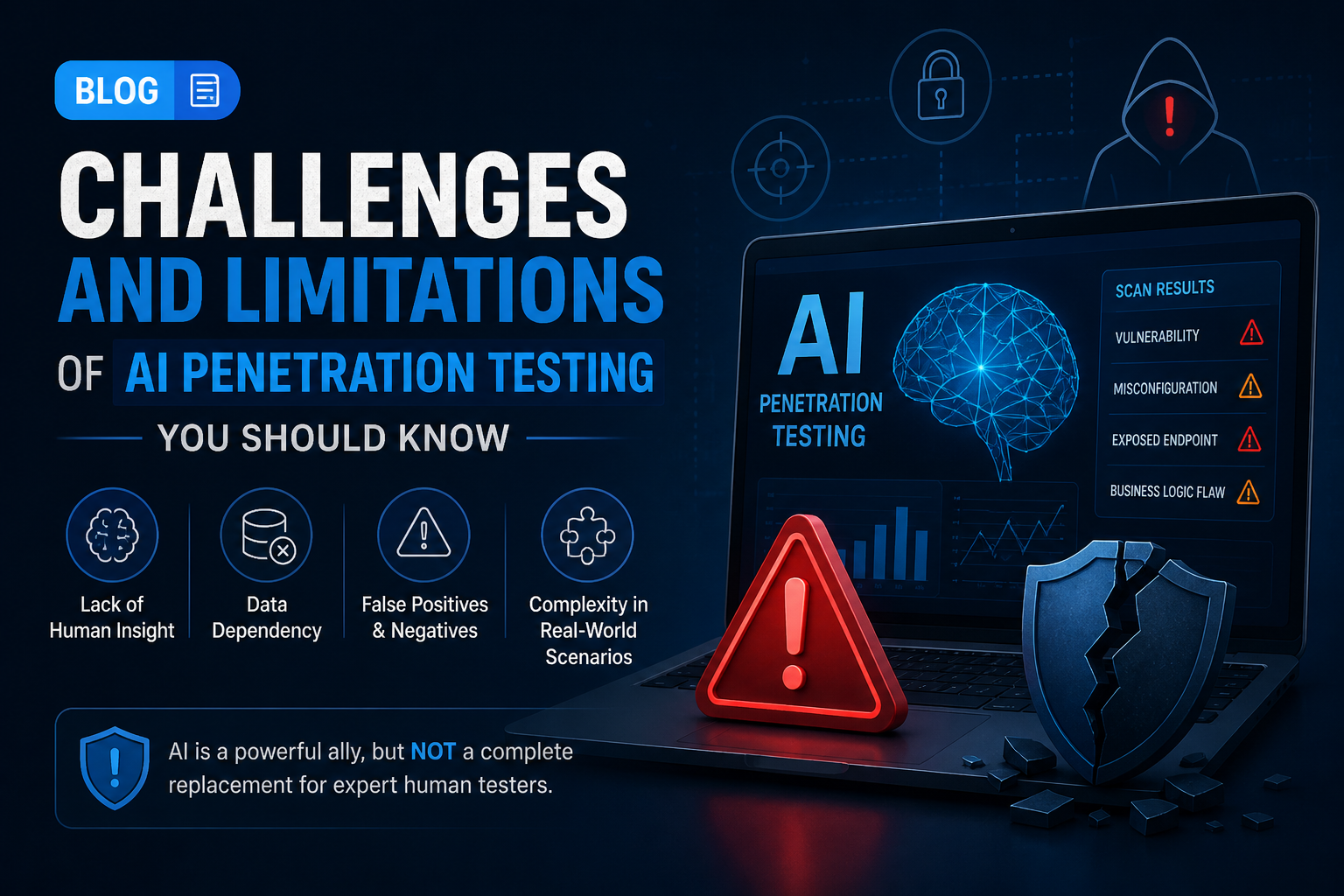
Cybersecurity threats are becoming more advanced, frequent, and difficult to detect. Organizations are under constant pressure to identify vulnerabilities before attackers exploit them. This has led to the growing adoption of AI penetration testing, which leverages automation, data analysis, and intelligent algorithms to simulate attacks and uncover security gaps.
While this approach offers significant advantages such as speed, scalability, and efficiency, it is not without its challenges and limitations. Relying entirely on AI-driven penetration testing can create blind spots and risks that organizations must understand. This article explores the key challenges and limitations of AI penetration testing and why a balanced approach is essential for effective security.
Understanding AI Penetration Testing
AI penetration testing refers to the use of intelligent systems to automate the process of identifying vulnerabilities in applications, networks, and infrastructure. These systems can scan large environments, detect patterns, and simulate attack scenarios much faster than traditional methods.
Unlike manual testing, which depends heavily on human expertise, AI-based systems rely on trained models, predefined rules, and historical data. This allows organizations to perform frequent assessments and detect issues in real time. However, this reliance on automation introduces several limitations.
1. Lack of Human Creativity and Intuition
One of the most significant limitations of AI penetration testing is its inability to replicate human creativity. Skilled penetration testers think like attackers, using intuition, experience, and unconventional methods to exploit vulnerabilities.
AI systems operate based on patterns and previously learned behaviors. While they can identify known vulnerabilities effectively, they often struggle with:
-
Complex attack chains
-
Business logic flaws
-
Context-specific vulnerabilities
For example, a human tester might notice a subtle flaw in how a payment workflow operates and exploit it in a creative way. An AI system, however, may overlook such issues because they fall outside predefined patterns.
2. Dependency on Training Data
AI systems are only as good as the data they are trained on. If the training data is incomplete, outdated, or biased, the results of AI penetration testing can be inaccurate.
Key concerns include:
-
Missing newly discovered vulnerabilities
-
Overlooking niche or industry-specific threats
-
Generating false positives or false negatives
Cyber threats evolve rapidly. Without continuous updates and high-quality datasets, AI systems can quickly become ineffective.
3. High False Positives and Negatives
AI penetration testing tools often produce a large number of alerts. Not all of these alerts represent real threats.
-
False positives: Reporting issues that are not actual vulnerabilities
-
False negatives: Missing real vulnerabilities
Both scenarios can be problematic. False positives waste time and resources, while false negatives create a false sense of security. Organizations may believe they are protected when critical vulnerabilities remain undetected.
4. Limited Understanding of Business Logic
Many critical vulnerabilities exist within business logic rather than technical configurations. These vulnerabilities arise from how applications are designed and used.
AI systems typically lack a deep understanding of:
-
User workflows
-
Application intent
-
Industry-specific processes
For example, a flaw allowing users to bypass payment steps or manipulate pricing might not be detected by automated systems. Human testers, on the other hand, can analyze workflows and identify such issues effectively.
5. Difficulty Handling Complex Environments
Modern IT environments are highly dynamic and complex. They often include:
-
Multi-cloud infrastructures
-
Microservices architectures
-
APIs and third-party integrations
AI penetration testing tools may struggle to fully map and analyze these environments. Misconfigurations, hidden endpoints, and dynamic changes can lead to incomplete assessments.
Additionally, large-scale environments may generate overwhelming amounts of data, making it difficult to prioritize vulnerabilities effectively.
6. Security of AI Systems Themselves
AI systems used for penetration testing can become targets themselves. Attackers may attempt to:
-
Manipulate training data (data poisoning)
-
Reverse-engineer models
-
Exploit weaknesses in the AI system
If compromised, these systems can produce misleading results or fail to detect vulnerabilities. This introduces an additional layer of risk that organizations must manage.
7. Lack of Contextual Decision-Making
AI penetration testing tools often lack the ability to make context-aware decisions. They can identify vulnerabilities but may struggle to assess:
-
The real-world impact of a vulnerability
-
The likelihood of exploitation
-
The business risk associated with an issue
Human experts play a critical role in interpreting findings and prioritizing risks based on organizational context. Without this, organizations may misallocate resources or overlook critical threats.
8. Compliance and Regulatory Challenges
Many industries require penetration testing to meet compliance standards such as:
-
SOC 2
-
ISO 27001
-
HIPAA
While AI penetration testing can assist in meeting these requirements, it may not fully satisfy compliance standards on its own. Regulatory frameworks often emphasize:
-
Manual validation
-
Documented methodologies
-
Human oversight
Relying solely on automated systems may lead to gaps in compliance and audit readiness.
9. Ethical and Legal Concerns
The use of AI in penetration testing raises ethical and legal questions. Automated systems can perform large-scale scans and simulations, which may:
-
Impact system performance
-
Trigger security alerts
-
Violate usage policies if not properly authorized
Organizations must ensure that all testing activities are conducted within legal boundaries and with proper permissions. Misuse of automated tools can lead to legal consequences and reputational damage.
10. Cost of Implementation and Maintenance
Although AI penetration testing can reduce long-term operational costs, the initial investment can be significant. Costs include:
-
Tool acquisition
-
Integration with existing systems
-
Continuous updates and maintenance
-
Skilled professionals to manage and interpret results
Smaller organizations may find it challenging to justify these expenses without a clear return on investment.
11. Over-Reliance on Automation
Automation is powerful, but over-reliance on it can be dangerous. Organizations that depend entirely on AI penetration testing may neglect:
-
Manual testing
-
Security awareness
-
Continuous monitoring
This can create blind spots and increase the risk of undetected vulnerabilities. A balanced approach that combines automation with human expertise is essential.
12. Limited Ability to Simulate Advanced Threat Actors
Advanced attackers use sophisticated techniques, including social engineering, multi-stage attacks, and zero-day exploits. AI penetration testing tools may struggle to replicate these scenarios accurately.
Human testers can simulate real-world attack strategies, adapting their approach based on the target environment. This level of adaptability is difficult for AI systems to achieve.
13. Integration Challenges
Integrating AI penetration testing tools with existing security infrastructure can be complex. Organizations often use multiple tools for:
-
Vulnerability management
-
Threat detection
-
Incident response
Ensuring seamless integration requires careful planning and technical expertise. Poor integration can lead to inefficiencies and incomplete security coverage.
14. Evolving Threat Landscape
Cyber threats evolve rapidly, with attackers constantly developing new techniques. AI systems must be continuously updated to keep pace with these changes.
Without regular updates, AI penetration testing tools may:
-
Miss emerging threats
-
Rely on outdated attack patterns
-
Provide inaccurate results
This ongoing need for updates adds to the complexity and cost of maintaining AI-driven security solutions.
Best Practices to Overcome These Limitations
To maximize the effectiveness of AI penetration testing, organizations should adopt a hybrid approach that combines automation with human expertise.
1. Combine AI with Manual Testing
Use AI tools for routine scans and data analysis, while relying on human testers for complex and creative assessments.
2. Regularly Update AI Models
Ensure that AI systems are trained on the latest threat intelligence and vulnerability data.
3. Validate Results
Always verify AI-generated findings through manual review to reduce false positives and negatives.
4. Focus on Context
Incorporate business context when assessing vulnerabilities to prioritize risks effectively.
5. Ensure Compliance
Align testing practices with regulatory requirements and include human oversight where necessary.
6. Invest in Skilled Professionals
Train security teams to work alongside AI tools and interpret results accurately.
Conclusion
AI penetration testing has transformed the way organizations approach cybersecurity by offering speed, scalability, and efficiency. However, it is not a complete replacement for human expertise. Limitations such as lack of creativity, dependency on data, and difficulty understanding business logic highlight the need for a balanced approach.
Organizations that rely solely on automation risk overlooking critical vulnerabilities and misinterpreting security risks. By combining intelligent tools with experienced professionals, businesses can achieve a more comprehensive and effective security strategy.
A hybrid approach ensures that both technical and contextual vulnerabilities are identified and addressed. Companies like Qualysec emphasize the importance of blending advanced technologies with expert-driven testing to deliver accurate, reliable, and comprehensive security assessments.

 English